High-Temperature Well Cementing and Integrity Workshop – Agenda Now Available!
St Vincent and the Grenadines: Confidence Shown in Improving Permeability at Geothermal Project
Permeability a continued challenge for SVG’s geothermal project (IWN)
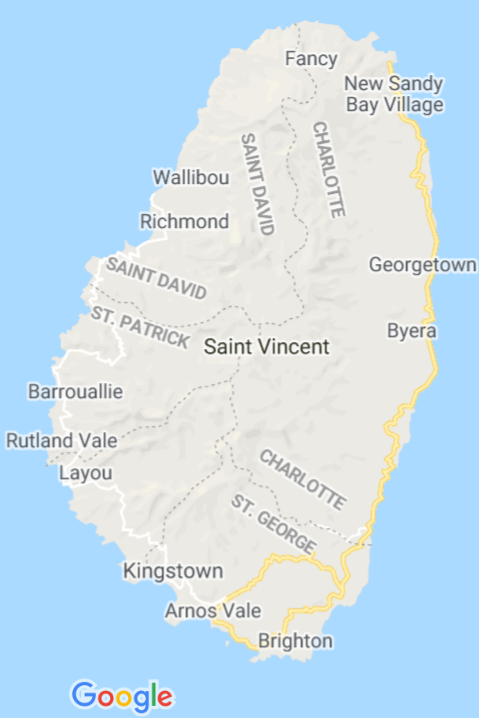
After all testing, the well capacity will be known and the economic analysis updated, sometime around July 2020.
None of the three wells dug as part of the geothermal energy project have the level of permeability required although they have registered the temperature necessary for the production of electricity.
And Prime Minister Ralph Gonsalves told Parliament last Wednesday that “The conclusion in all of this as provided by the technical persons is that although the results in relation to the permeability have not gone favourably due to the very tight fractures that have limited the permeability, the tested temperatures on the wells were adequate for geothermal power,” Prime Minister Ralph Gonsalves told Parliament last Wednesday.
The prime minister said that the technical team will exhaust all options of well stimulation in an effort to open the fractures on the three wells and improve permeability.
He said that the technical team is optimistic that following the successful stimulation results of the well SVG 03, “they are hopeful that the others will be similar and in addition, strengthen the stimulation in 03”.
Read More………..
From the Global Geothermal News archives:
- Friday, November 1, 2019 – St Vincent and the Grenadines: Geothermal Project Achieves Good Results from Second Well
- Friday, August 16, 2019 – St Vincent and the Grenadines: First Well at Geothermal Project Encounters Permeability Problems
- Friday, July 12, 2019 – St Vincent and the Grenadines: Geothermal Project Reaches 250 Degree Celsius Resource at 2500 Meters
- Tuesday, May 7, 2019 – Saint Vincent and the Grenadines: Drilling Starts at 10 MW Geothermal Power Plant Site
Switzerland: Better Coordination is Needed to Promote Geothermal Energy – Paper
Entanglement of Top-Down and Bottom-Up: Sociotechnical Innovation Pathways of Geothermal Energy in Switzerland (ETH Zurich)
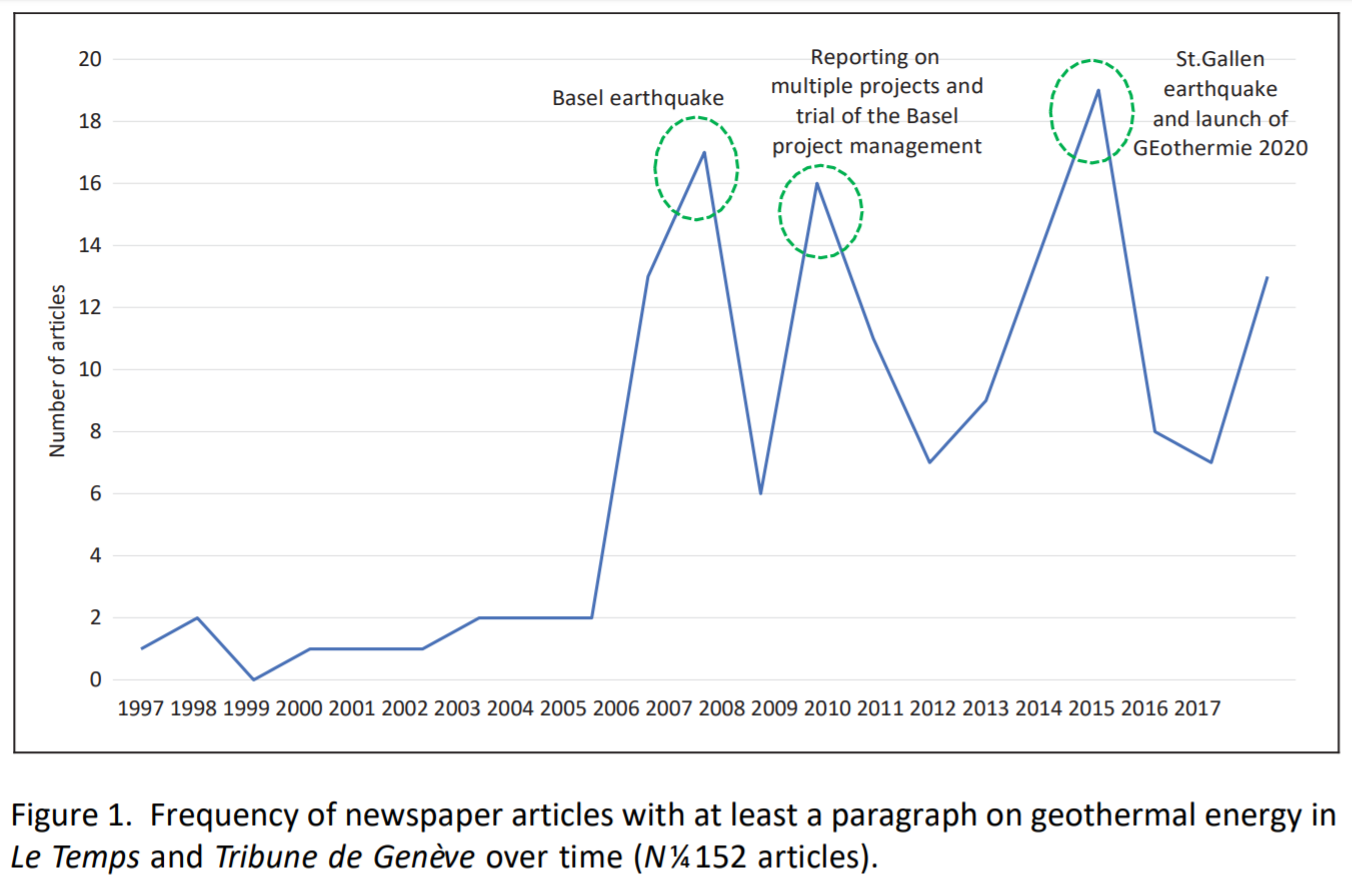
By looking at deep geothermal energy in Switzerland, this article illustrates
how innovation pathways in federal countries take entangled forms between top-down and bottom-up.
The Swiss federal government presents deep geothermal energy as an important technology to decarbonize electricity production. Setbacks in early projects have slowed these efforts. Despite strong policy incentives from the federal government, no electricity is being produced from geothermal projects in Switzerland in 2019.
Based on four case studies, we analyze how some cantons and cities have taken different pathways: Rather than implementing federal objectives, they favor heat
production instead of electricity generation. The relative success of these initiatives led federal authorities to modify their approach to promoting geothermal energy.
This study shows that federal mechanisms and instruments alone are not enough to make energy infrastructures acceptable locally. To learn from bottom-up experiences and adapt federal policies to local reality, better coordination between the federal and subnational levels is needed.
Ejderyan O, Ruef F and Stauffacher M (2019) Entanglement of Top-Down and Bottom-Up: Sociotechnical Innovation Pathways of Geothermal Energy in Switzerland. The Journal of Environment & Development: 107049651988600. Available from: http://journals.sagepub.com/doi/10.1177/1070496519886008.
Canada: Fort Nelson Geothermal Power Project Gets Green Light
Geothermal clean-energy project moves forward in Fort Nelson (My Prince George Now)

The Fort Nelson First Nation has received a permit from the Province that will allow them to move forward with a planned geothermal project.
When finished, the project will provide a reliable source of clean and renewable energy to those in the area, which is currently not attached to BC’s electrical grid and heavily relies on fossil fuels from Alberta.
The permit grants geothermal resource rights to Deh Tai GP Inc., a development company of the Fort Nelson First Nation.
Awarded rights would be for nearly 6,800 hectares of land in the Clarke Lake gas field, located in the northeast corner of the province.
Unlike wind, solar, and river projects, which are intermittent, geothermal is an extremely stable and firm source of electricity.
From the Global Geothermal News archives:
- Wednesday, September 25, 2019 – Canada: Report Concludes Potential for Combined Geothermal Power and Heat Plant at Repurposed Gas Field
- Friday, August 23, 2019 – Canada: Government Invests in Geothermal Resource Survey in Northern British Columbia
Canadian MAID (euthanasia) online consultation questionnaire was a sham and the data is unreliable.
Alex Schadenberg
Executive Director, Euthanasia Prevention Coalition

On January 14, I wrote an article urging EPC supporters to participate in the Canadian Department of Justice Medical Assistance in Dying (MAiD) consultation questionnaire. In my article I stated:
The language of the consultation questionnaire is not great, nonetheless, the questionnaire does allow you to leave further comments.
 |
| Alex Schadenberg |
On January 15, I published a guide to answering the Canadian MAID euthanasia questionnaire. I am pleased to report that more than 18,000 different people used the guide.
The online consultation is now closed and the Department of Justice has stated that 280,000 Canadians participated in the online consultation.
Here is my experience with the process.
The online consultation questionnaire was a sham.
Many of the questions implied an outcome. It is a sham to ask people to complete a questionnaire when some of the questions are designed to provide a predetermined outcome.
For instance, Question 2 asked about safeguards. Question 2a asked:
A different reflection period (currently a 10-day reflection period) between the submission of a person’s written request for MAID and receiving MAID.
The answers to this question lacked meaning because they didn’t indicate whether it is important to maintain the waiting period, increase the waiting period or remove the waiting period. In other words, the data is useless.
The other (Question 2) safeguard questions assume that the participant supports MAID.
Once again, the only good part of the consultation questionnaire is that it provided a box (500 words) that enabled the participant to offer their concerns or thoughts.
The online consultation questionnaire was fraudulent.
After encouraging our supporters to participate in the consultation questionnaire, I began to receive emails stating that the website kicked them out as they completed the questionnaire. I simply urged these people to try again.
The second complaint was far more of an issue. Several of our supporters indicated that the consultation website enabled them to complete the questionnaire more than once. One person contacted me stating that he had completed the questionnaire more than 50 times from the same computer.
I did not encourage this nor did I tell others about this problem. I only encouraged our supporters to participate in the questionnaire that was questionable to begin with.
If one of my supporters completed the questionnaire more than 50 times, how many euthanasia supporters did the same?
The Department of Justice stated that 280,000 people completed the questionnaire. Since the website did not prevent people from participating multiple times they have no idea how many people actually participated and the data collected in the online consultation is unreliable.
If the government wanted to do a proper consultation it would have asked clear questions that were written in a neutral manner and enabled people, who oppose killing, to answer in that manner.
Since some of the questions implied support for euthanasia many of our supporters refused to participate.
If you have any comments or concerns, email me at: alex@epcc.ca
Question 2a concerning the 10 day “reflection period” lacked meaning and is therefore null and void. Based on the online questionnaire, the government cannot conclude that the questionnaire provided data for a policy to: maintain, extend, or remove the waiting period.
EPC asked our supporters to participate in the online consultation questionnaire.
Other than the odd story, the media and the government have ignored the failures of Canada’s euthanasia law, even though there are several key problems and abuses of the law.
If you have any comments or concerns, email me at: alex@epcc.ca
For further information please read some of these articles:
- Historical: Canadian Senate passed euthanasia law in time for summer break (Link).
- Approximately 5000 Canadians died by assisted death in 2019 and 13,000 assisted deaths since legalization (Link).
- Ontario euthanasia deaths are rising quickly (Link).
- UN Disability rights envoy urges changes to Canada’s euthanasia law (Link).
- Québec court expands euthanasia law by striking down the terminal illness requirement (Link).
- Physically healthy depressed man died by euthanasia in BC (Link).
- Ontario doctor experiences abuse of euthanasia law (Link).
- Québec Fourth Interim Euthanasia Report, 13 deaths did not comply with the law (Link).
- BC Health Minister orders Delta Hospice to do euthanasia by February 3 (Link).
Indonesia: PT PLN (Persero) to Issue Renewable Energy Certificates to Boost Production
PLN to issue tradable renewable energy certificates to promote clean energy (Jakarta Post)
 |
| (Courtesy CIA.gov) |
State-owned electricity firm PLN will issue renewable energy certificates (REC) to support the government’s program to promote the use of clean energy in the country in cooperation with Clean Energy Investment Accelerator (CEIA) Indonesia.
PLN deputy president director Darmawan Prasodjo said the certificate issuance was part of the company’s efforts to push the country’s clean energy agenda by making more use of renewable sources, such as wind, sun, geothermal power and hydropower.
He said PLN currently had renewable energy plants with a combined capacity of 7,681 megawatts and planned to increase that to more than 15,000 MW by 2028. “We need to balance [economic] growth with environmental sustainability; the prosperity of this generation must be passed on to future generations,” Darmawan told reporters.
USA, California: Policymakers Beginning to See the Potentially Extraordinary, but so far Unrecognized Value of its Geothermal Resources
Geothermal’s surprise: Cheap renewables could keep states from achieving climate goals (Utility Dive)
Planners must think beyond the levelized cost for renewables to the value that each resource brings to the grid.

Surprisingly, the plunging cost of some renewables could keep states from reaching ambitious climate goals if planners fail to recognize the higher value in some higher cost renewables.
States like New York, Massachusetts and California with ambitious 2030 renewables and 2045 emissions reduction mandates are starting to find a tension between cost and value. Offshore wind’s reliability and emissions reduction values have raised its profile, though it remains more expensive than onshore wind. Now California policymakers are beginning to see the potentially extraordinary, but so far unrecognized value of its geothermal resources.
Finance: Surge in Corporations Directly Buying Renewable Energy
Corporate Clean Energy Buying Leapt 44% in 2019, Sets New Record (BNEF)
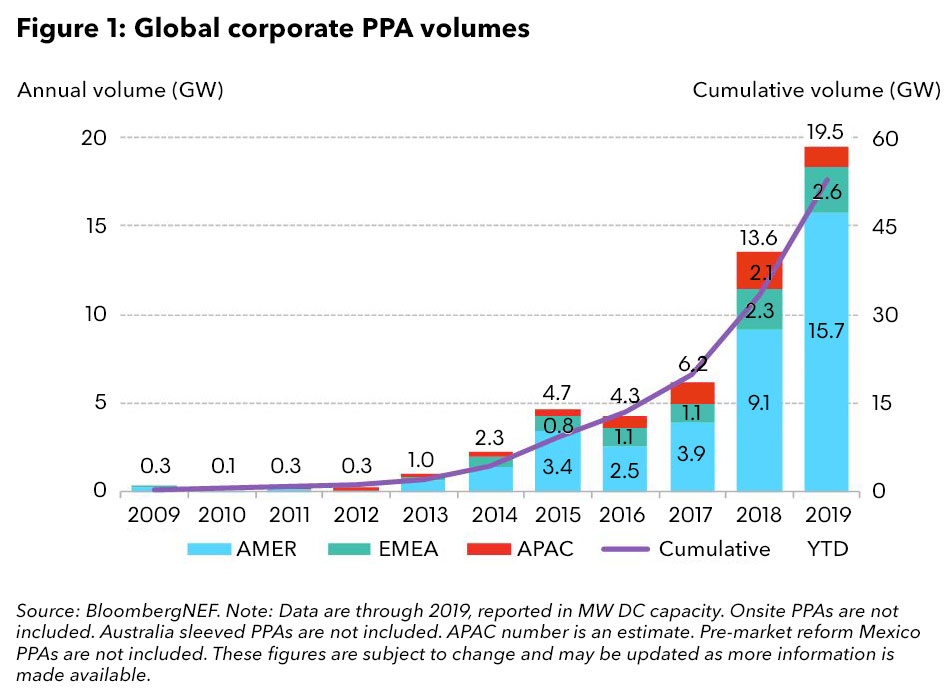
Corporations bought a record amount of clean energy through power purchase agreements, or PPAs, in 2019, up more than 40% from the previous year’s record. The majority of this purchasing occurred in the United States, but also underpinning the strong uptrend is a surge in corporate sustainability commitments around the world.
BloombergNEF (BNEF) finds in its 1H 2020 Corporate Energy Market Outlook, published today, that some 19.5GW of clean energy contracts were signed by more than 100 corporations in 23 different countries in 2019. This was up from 13.6GW in 2018, and more than triple the activity seen in 2017.
Switzerland: Geothermal Heat to Help Expand District Heating Network in Davos
La géothermie à moyenne profondeur à Davos – un schéma pour l’espace alpin ? – Medium-depth geothermal energy in Davos – a blueprint for the Alps? (Geothermie Suisse)

La commune de Davos mise sur l’énergie indigène et renouvelable ainsi que sur l’efficacité énergétique. Une part importante de la stratégie politique en matière d’énergie est l’utilisation accrue de la géothermie. Dans ce but, Davos, en sa qualité de Cité de l’énergie, a déjà lancé un projet pilote voilà une dizaine d’années. Les enseignements tirés lors de cette décennie sont désormais disponibles sous forme de rapport.
(From Google Translate) The municipality of Davos relies on indigenous and renewable energy as well as energy efficiency. An important part of the political energy strategy is the increased use of geothermal energy. To this end, Davos, as the City of Energy, already launched a pilot project some ten years ago.The lessons learned during this decade are now available in the form of a report.
USA, California: Geothermal Resources Council Southern California Section Meeting
Meeting of the SoCal Section of the Geothermal Resources Council
A celebration of Life for Brian Berard.
31 January at 3 pm at the American Legion in Brawley located at 509 G St, Brawley, CA 92227
Brian was a proud Cajun and always looking for a good excuse to have a crawfish boil. In his honor, there will be a crawfish and shrimp boil and an open microphone for everyone to share memories.
Thank you for the kind support from Baker Hughes for providing the crawfish and shrimp, and to Geo Drilling Fluid, San Joaquin Bit, CGE Services Geo Resource Management and more to come. Any remaining funds will be given to Brian’s family.
Everyone is welcome. Please feel free to share this invite with Brian’s friends and colleagues.
The Man:

Brian Berard spent three decades working in geothermal, beginning in Ridgecrest, CA, during the drilling and development of the Coso geothermal project. He spent most of his career with California Energy, now CalEnergy, and retired as the Geothermal Resource Manager in June 2017.
He contributed much to the Coso and Salton Sea fields, and explored Nevada’s geothermal resources for a couple years.
Brian was originally from Louisiana and trained as a geologist and geophysicist. Prior to moving to California, he served in the Navy and worked in the oil and gas industry of Louisiana and Texas.
All are welcome at SoCal GRC Section meetings free of charge, thanks to our generous meeting sponsors. Please RSVP to mary@geothermalresourcegroup.com.
 German News, German Breaking News, German Latest News