The Great Game Round-Up brings you the latest newsworthy developments regarding Central Asia and the Caucasus region. We document the struggle for influence, power, hegemony and profits between a U.S.-dominated NATO, its GCC proxies, Russia, China and other regional players.
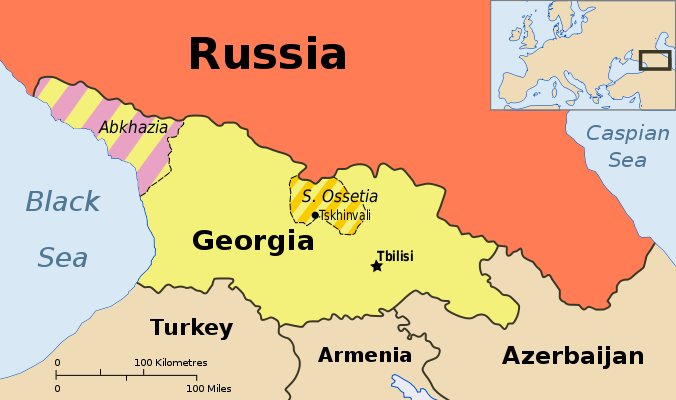
With the Russia-Georgia war approaching its fifth anniversary, Russian Prime Minister Medvedev used the opportunity to discuss the relationship between the two countries. He voiced his optimism for an improvement of the relations as soon as Georgian President Saakashvili will leave office and praised Prime Minister Ivanishvili:
But as Dr. Paul Craig Roberts noted, Saakashvili did not act on his own:
“Most analysts regard it as unlikely that Saakashvilli on his own would violate the peace agreement and attack Russian troops. Certainly Saakashvilli would have cleared the aggression with his Washington sponsor.
Saakashvilli’s attempt to recover the territories was an opportunity for Washington to test Russia. Washington saw the attack as a way of embarrassing the Russian government and as a way of testing Russia’s response and military in action. If Russia did not respond, the government would be embarrassed by its failure to protect its interests and the lives of those Russia regards as citizens. If Russia did respond, Russia could be denounced, as it was by President George Bush, as a bully that invaded a “democratic country” with a Washington-installed president. Especially interesting to Washington was the ability to observe the Russian military’s tactics and operational capabilities.”
 German News, German Breaking News, German Latest News