The Great Game Round-Up brings you the latest newsworthy developments regarding Central Asia and the Caucasus region. We document the struggle for influence, power, hegemony and profits between a U.S.-dominated NATO, its GCC proxies, Russia, China and other regional players.
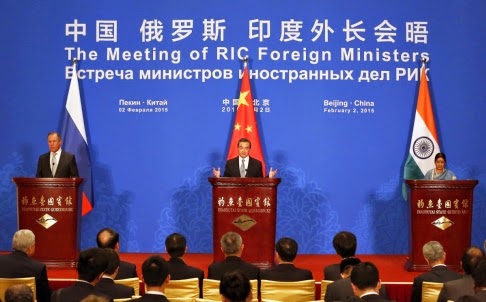
At the end of last month, U.S. President Barack Obama made history with his three-day visit to India. Obama became the first American leader to be honored as chief guest at India's annual Republic Day parade and the first U.S. President to visit India twice in his tenure. His trip has been hailed as a milestone in Indo-American relations because it allegedly demonstrates that India is tilting toward the U.S. in its foreign policy, ending its policy of non-alignment. It is indeed possible that India will end its non-alignment policy in the foreseeable future but it is doubtful that this entails closer Indo-American ties. Obama did his best to destroy his popularity with the people in India and Prime Minister Narendra Modi is not a big fan of Washington anyway. As previously discussed, Modi's election paved the way for a rapprochement between India and China, culminating in Beijing's endorsement of India's accession to the Shanghai Cooperation Organization (SCO). To make matters worse for the U.S., the Modi government has refused to reconsider India's policy toward Moscow and strengthened the strategic partnership with Russia. This week's trilateral meeting between the foreign ministers of India, Russia and China revealed the synergy between the three countries:
India and Russia back China's call for 'new world order'
Russia and India added their voices on Monday to China's call for a new world order and endorsed Beijing's plans to mark the 70th anniversary of the end of the second world war.
In a joint communique, the three nations vowed to “build a more just, fair and stable international political and economic order” and a “multi-polar” world.
Russian Foreign Minister Sergey Lavrov said all states should be involved in creating “a modern security architecture” in the Asia-Pacific; his Chinese counterpart, Wang Yi , said the region should not be caught up in a zero-sum game.
 |
| © Photo EPA |
 German News, German Breaking News, German Latest News