Euthanasia pushed as boon to Organ Donation.

This article was published by National Review online on January 6, 2020.
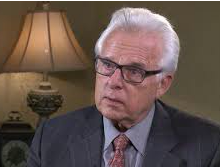
Wesley J Smith

By Wesley J Smith

My very first anti-euthanasia column, published in Newsweek, warned that societal acceptance of assisted suicide/euthanasia would eventually include organ harvesting “as a plum to society.” I was called an alarmist and a fear-monger, but alas, I was right. In Belgium and the Netherlands, mentally ill and disabled people are killed in hospitals at their request, and then, their bodies are harvested — with the success of the procedures written up with all due respect in organ-transplant medical journals.

Our closest cultural cousins in Canada are enthusiastically following the same utilitarian path, not only allowing organ harvesting to be conjoined with euthanasia, but “medically assisted death” is being boosted increasingly as “a boon.” Note the celebratory lede in this Ottawa Citizen story:

Ontarians who opt for medically assisted deaths (MAiD) are increasingly saving or improving other people’s lives by also including organ and tissue donation as part of their final wishes. 

In the first 11 months of 2019, MAiD patients in the province accounted for 18 organ and 95 tissue donors, a 14 per cent increase over 2018 and a 109 per cent increase over 2017. (Figures for December 2019 are not yet available.) 

According to Trillium Gift of Life Network, which oversees organ and tissue donation in Ontario, the 113 MAiD-related donations in 2019 accounted for five per cent of overall donations in Ontario, a share that has also been increasing. In 2018, MAiD-related donations made up 3.6 per cent of the province’s total donations, and in 2017 just 2.1 percent.

Many of these killed organ donors will not have been imminently dying. They will also generally not have been provided suicide-prevention services as the suicidal ill and disabled who ask for euthanasia are increasingly abandoned to the “death with dignity” mindset in Canada.

It doesn’t even have to be the patient’s idea. Trillium Gift of Life Network, Ontario’s donation organization, actively solicits the organs of those soon to be killed by doctors!

Canada decriminalized medically assisted death in 2016, and Ontario, through Trillium, immediately moved to the forefront of organ and tissue donation through MAiD, becoming the first jurisdiction in the world to proactively reach out to those who had been approved for assisted death to discuss donation.  When a death is imminent, whether through a hospital or MAiD, Trillium must by law be notified. 

“And, as part of high-quality end-of life care, we make sure that all patients and families are provided with the information they need and the opportunity to make a decision on whether they wish to make a donation,” [Trillium CEO Ronnie] Gavsie says. “That just follows the logical protocol under the law and the humane approach for those who are undergoing medical assistance in dying. And it’s the right thing to do for those on the wait list.”

The clear message being sent to suicidal ill and disabled Canadians — with the active support of the organ transplant community — is that their deaths can have greater value to Canada than their lives. In other words, organ donation as an offshoot of euthanasia has indeed been defined “as a plum to society.”

Someday, Canada will probably dispense with the euthanasia part altogether and go straight to killing by organ harvesting — already being proposed bioethics and medical journals. That would make for more viable organs, don’t you know. Once one gets past what bioethicists denigrate as “the yuck factor,” there is indisputable logic to that idea, which we could call fruit from a legally poisonous tree.

Those with eyes to see, let them see.
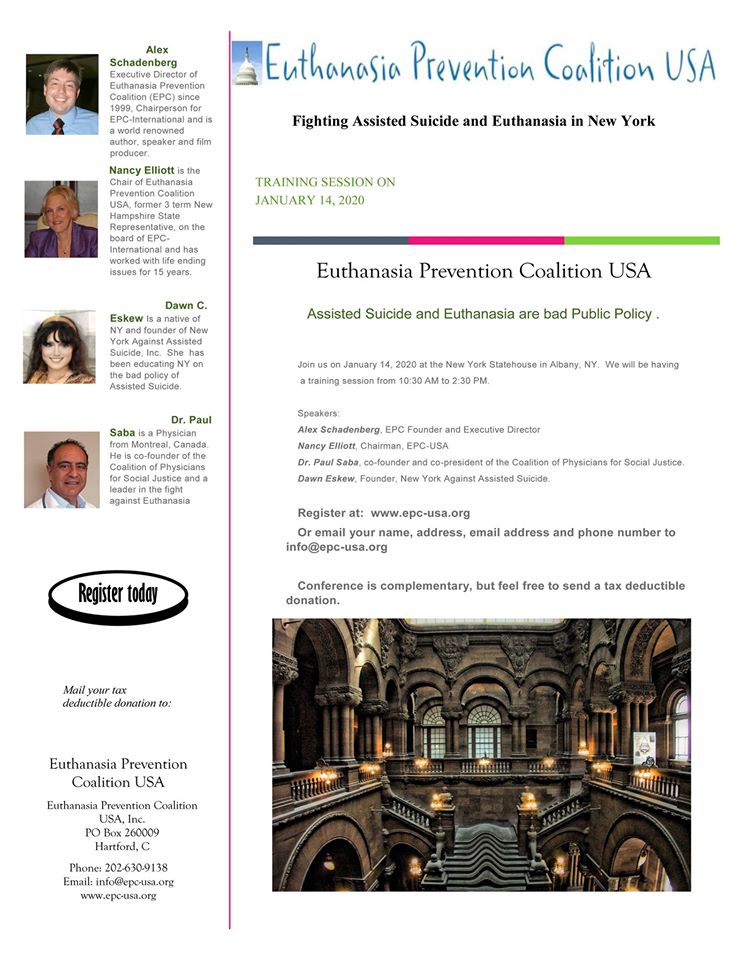
Conference (January 14): Fighting assisted suicide in New York.

This article was published by OneNewsNow on January 6, 2020.

Opponents of assisted suicide are organizing to fight the legalization of the practice in New York.

The New York Legislature will soon debate on whether the state will make it legal for doctors to prescribe lethal drugs to assist a person in taking his or her own life.

“Sadly, the push in New York is but one of the strongest in the nation,” Alex Schadenberg of the Euthanasia Prevention Coalition tells OneNewsNow. “The governor has stated that he wants assisted suicide legalized. There’s a bill that’s ready to go. They also have a situation where recently New Jersey has legalized assisted suicide.”

The neighboring state’s law went into effect last summer. But while proponents have momentum, so do the opponents. Schadenberg will be hosting an event later this month at the state capitol to organize and focus the latter group.

“The January 14th event is featuring quite a few people from different perspectives, but the fact of it is there’s physicians, there’s people with disabilities, there’s legislators, there’s people who are going to be opposing assisted suicide,” the Coalition leader asserts.

Schadenberg has 20 years of experience of clearly indicating the fallacies of assisted suicide, including in Oregon, where the laws dealing with the practice are not enforced. Still, it is legal in a total of seven states and Washington, D.C.

Geothermal Event! Call for Papers – Deadline is May 27, 2020

GRC Annual Meeting 2020 – Call for Papers (News Release)

Geothermal Resources Council Annual Meeting will be held in Reno, Nevada, USA

The Geothermal Resources Council (GRC) has issued a call for papers for the world’s biggest annual geothermal energy conference taking place October 18-21, 2020, at the Peppermill Resort Spa & Casino, Reno, Nevada, USA.

The GRC Annual Meeting & Expo is the industry’s largest annual gathering of leading geothermal energy scientists, producers, renewable energy industry stakeholders, regulators, utilities, and key associated business leaders. The four-day event will offer technical, policy, and market conference sessions, educational seminars, tours of local geothermal and renewable energy projects, and numerous networking opportunities.

Nearly 1,000 attendees came to the 2019 GRC Annual Meeting and Expo from just under 40 different countries, highlighting the GRC’s role in connecting the global geothermal energy community. With increasing interest in geothermal as a reliable source of renewable energy providing both flexible and baseload power production around the world, the GRC is looking ahead to an even stronger international attendance in 2020.

Read more »

USA: Registration Opens for 2020 Geothermal Design Challenge

2020 Geothermal Design Challenge™: GIS Mapping Student Competition (INL)

Registration is Now Open

The U.S. Department of Energy (DOE) Geothermal Technologies Office (GTO), in conjunction with Idaho National Laboratory (INL), is hosting the 2020 Geothermal Design Challenge™: GIS Mapping Student Competition. The design challenge focuses on a non-technical barrier to geothermal development to foster understanding and share the benefits of geothermal energy technologies. Student teams of two or three will use GIS mapping to create a compelling infographic/poster or interactive map to discover potential opportunities from this renewable energy source.

“Geothermal energy is difficult to understand because it is located underground. How can geospatial mapping increase our understanding of this important renewable energy resource? How can GIS improve how we visualize and communicate about geothermal energy?”

Create a map (digital interactive or static) showing how GIS could portray or enhance the communication of geothermal technology.

  • Registration opens Jan. 6, 2020 (8 a.m. ET)
  • Round 1 – Draft Submission Compliance Review: March 30 (Skild site temporarily closed at 10 p.m. ET) – April 3, 2020 (Skild site re-opens 5 p.m. ET)
  • Participants must pass the Compliance Review to advance to Round 2
  • Participants advancing to Round 2 notified: April 6, 2020
  • Round 2 – Final Submissions due: April 12, 2020 (10 p.m. ET)
  • Winners announced: April 22, 2020

Register Now………

Philippines: Lush Forests Help Geothermal Energy Recharge Reservoir

EDC vows to continue reforestation of Mt. Talinis this 2020 (Philippine News Agency)

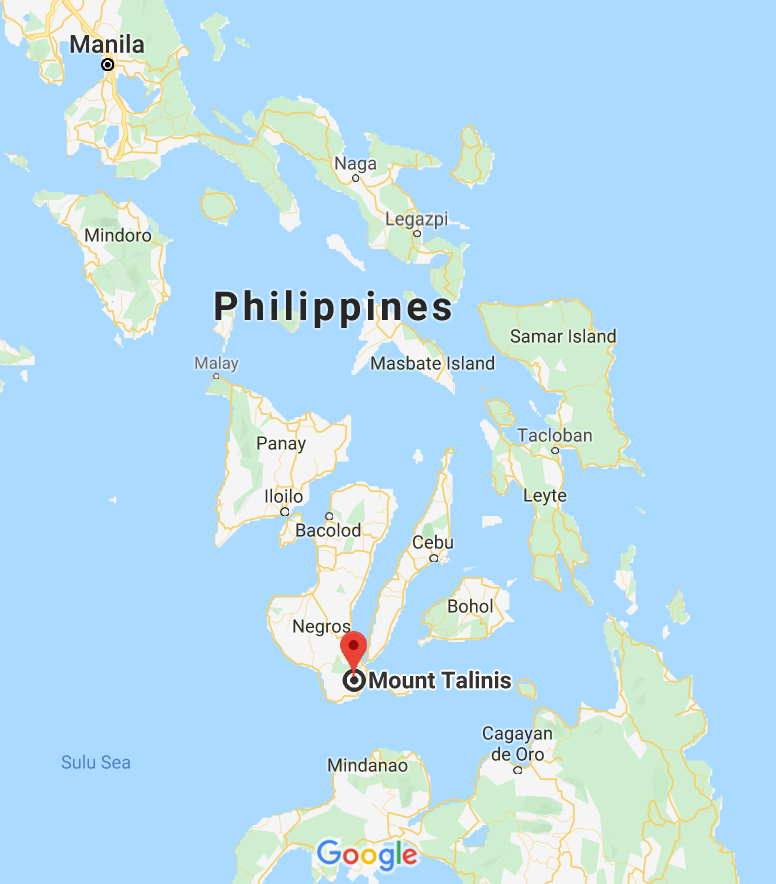
Geothermal power leader Energy Development Corporation (EDC) has vowed to continue to reforest Mt. Talinis in Negros Oriental as part of its massive greening efforts of the entire Negros Island.
Norreen Bautista, head of EDC’s Corporate Social Responsibility in Negros Island and Mt. Apo in Mindanao stressed that lush forests will help geothermal energy recharge its reservoir, as trees will hold and release water deep into the earth.
“Otherwise, geothermal steam fields will dry up and will not be able to produce enough steam to run its power plants,” she said.
EDC has been planting and maintaining forests in Negros Oriental where it has been generating clean, renewable, and reliable geothermal facilities for over 36 years, an EDC media release said over the weekend.

Poland: 12 MWth Geothermal District Heating Network Provides 30% of Heat for Stargard Municipality

Geotermia może dać plus. Stargard pokazuje, jak to się robi – Geothermal energy can give a plus. Stargard shows how to do it (Portal Samorzadowy)

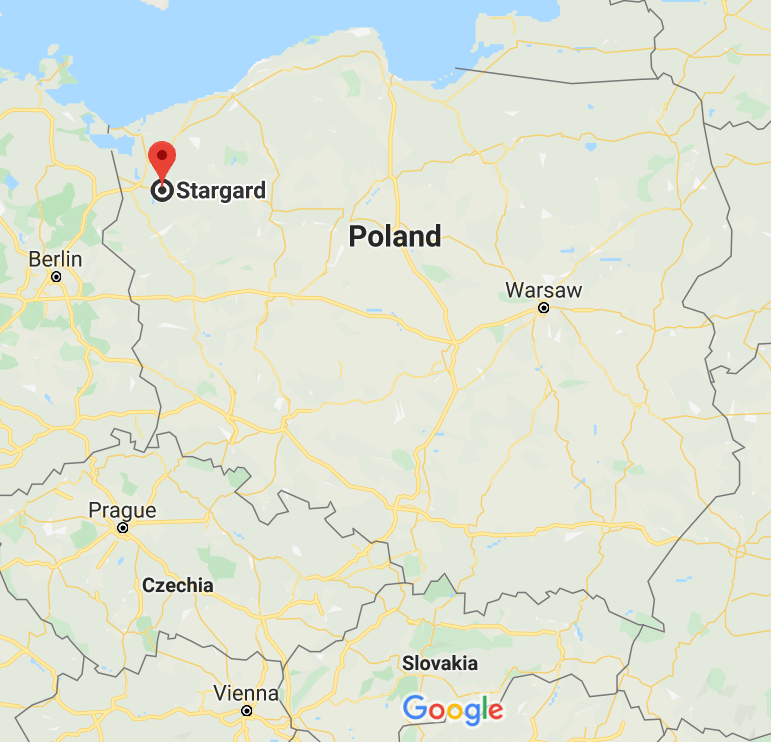
Rozmawiamy z Arkadiuszem Biedulskim, prezesem zarządu G-Term Geotermia Stargard, wiceprezesem Polskiego Stowarzyszenia Geotermicznego. Geotermia Stargard jest drugą największą ciepłownią geotermalną w Polsce, jedną z dwóch sprzedających wyłącznie ciepło geotermalne. Roczna produkcja ciepła wynosi ok. 200 tys. GJ i pokrywa ponad 30 proc. zapotrzebowania sieci miejskiej. W przyszłości będzie to 70 proc.
(From Google Translate) We talk to Arkadiusz Biedulski, president of the board of G-Term Geotermia Stargard, vice president of the Polish Geothermal Association. Geothermal Stargard is the second largest geothermal heating plant in Poland, one of two selling only geothermal heat. The annual heat production is about 200 thousand GJ and covers over 30 percent urban network demand. In the future it will be 70 percent.

Czytaj więcej………..                            Read More………..

Science & Technology: “Training” the Geothermal Reservoir Before the Stimulation Process Begins Reduces Risks of Induced Seismicity – Researchers

Reducing human-induced earthquake risk (EPFL)

Researchers at l’Ecole Polytechnique Fédérale de Lausanne (EPFL) and the Swiss Federal Office of Energy have devised strategies for reducing the earthquake risk associated with geothermal energy, CO2 storage and other human activities happening deep underground.
The researchers came up with the idea of “training” the reservoir before the stimulation process begins. In the case of a reverse fault, which involves high horizontal stresses, cold fluid is injected underground over a period of at least 12 months. “As the reservoir cools, the rock contracts,” explains Fryer. “This lowers the horizontal forces acting on it, thereby reducing differential stress and making earthquakes less likely.”
This research provides important insights for industry, potentially helping companies devise ways to reduce the likelihood of induced seismicity. “Understanding every possible scenario and acting accordingly could pave the way for some promising real-world applications,” says Siddiqi.

USA, California: Calpine Finds Solution to Re-Power Waste-Water Pumps for Geysers Geothermal Field

Santa Rosa wastewater quandary linked to Kincade fire could get worse as rainy season ramps up (The Press Democrat)

Nearly two months after the Kincade fire was fully contained in northeastern Sonoma County, Santa Rosa is struggling with an after-effect of the massive blaze: its wastewater disposal pipeline at The Geysers was disabled for six weeks, backing up the Sebastopol-area plant with about 400 million gallons of treated wastewater.
[A] high-voltage line previously powered the city-owned pumps that deliver water about 40 miles from Santa Rosa’s Laguna Wastewater Plant to The Geysers as part of the city’s wastewater disposal system, in operation since 2003.
Without electricity from that line, Santa Rosa found itself sidelined for six weeks — without the ability to pump the 15 million gallons of wastewater it regularly sends per day on average to help sustain steam power at The Geysers, said Joe Schwall, the city’s deputy director of water reuse operations. 
The fire did not damage the city’s pumps, according to Schwall, though it burned at least eight Calpine utility poles that link its system of more than a dozen geothermal power plants to PG&E’s grid. And the transmission line that went down the night the fire erupted remained out of service for about a month after the fire was contained, leaving the pumps without power even after Calpine replaced its poles.
PG&E projected the transmission line, and by extension, Santa Rosa’s pumps, would remain out of service until Jan. 22 as crews worked in the difficult terrain of the Mayacamas Mountains, often relying on helicopters for repair work.
But Calpine was able to find a workaround — rewiring its private system of lines without the downed PG&E line — to restore service to Santa Rosa’s pumps beginning Dec. 5, said Schwall, crediting the company for finding a solution.
“They apparently found a route that they don’t normally use to route the electricity through their lines to use,” he said

USA, Hawaii: Ormat to Replace Ten Steam Units at Puna Geothermal Venture with Two Binary Units

Ormat’s Puna Geothermal Venture and Hawaiian Electric Announce Amended Power Purchase Agreement (News Release)

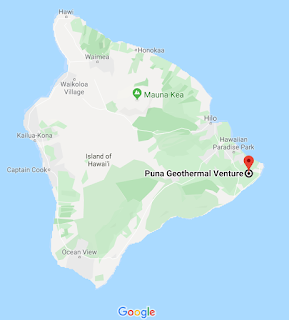
Ormat Technologies, Inc. today announced that its subsidiary, Puna Geothermal Venture (PGV), and Hawaiian Electric’s Hawaii Electric Light subsidiary have reached an agreement on an amended and restated power purchase agreement (PPA) for dispatchable geothermal power sold from Ormat’s Puna complex, located on the Big Island of Hawai’i. 
The new PPA extends the term until 2052 with an increased contract capacity of 46 MW and a fixed price of $70.00/MWh with no escalation, regardless of changes to fossil fuel pricing. The amended PPA was filed with the Public Utilities Commission (PUC) on December 31, 2019 for its review and approval, which is anticipated during 2020.
Ormat is planning to replace ten 25-year-old steam units with two new Ormat binary units and to upgrade the existing auxiliary equipment. This upgraded facility will utilize the same amount of geothermal resource that the existing 38 MW facility requires. The modern equipment, with increased efficiency, will increase the Puna complex generating capacity by 8 MW to a total of 46 MW and will significantly reduce the operating costs. The commercial operation date (COD) of the new plant is expected during the first half of 2022. The existing PPA remains in effect, with current terms, until the expansion is completed, and the new plant reaches its COD.

Global: Kelly Blake and Elisabeth de Jong Join the Board of Geothermal Resources Council

Geothermal Resources Council Announces New Board of Directors

Two new members join the GRC Board of Directors

The Geothermal Resources Council (GRC) is governed by a Board of Directors, elected by the general membership to 2-year terms. To provide continuity, an election is held every year. All GRC members are eligible for election to the Board of Directors.

Kelly Blake
Elisabeth
de Jong

The global GRC membership took part in the ballot in November, and the result was that two new members of the Board were elected: Kelly Blake and Elisabeth de Jong.

They join two other members who have been re-elected to the Board of Directors: Ann Robertson Tait and Josh Nordquist.

The diverse membership of the Board of Directors reflects the mission of the GRC to represent the entire global geothermal community.

Will Pettitt, Executive Director of the GRC commented, “We congratulate the elected members of the Board on their success and welcome their talents and commitment. Our new board is 21 strong with 38% women. We continue to develop a diverse organization and strive for balanced gender representation. I look forward to working with the new Board on our transformative 2020 vision of increasing public awareness of geothermal energy across society.”

Photos of the new Board of Directors can be seen on the GRC Website at https://geothermal.org/bod.html

As of December 2019, the membership of the GRC stands at just under 1,200 with representation from nearly 40 different countries. If you would like to connect with this global geothermal community please consider joining the GRC and enjoy all the benefits of our association. As a GRC member you can also run for election to the Board of Directors and serve on Board committees. More information can be found at https://geothermal.org/membership.html

Design a site like this with WordPress.com
Get started