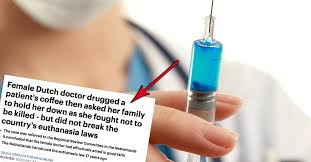
The assisted suicide lobby opposes Oregon bill expanding the law to euthanasia.

Alex Schadenberg
Executive Director – Euthanasia Prevention Coalition
Oregon Senate

The Oregon legislature is currently debating assisted suicide bill Bill HB 2217 to expand the assisted suicide law and permit euthanasia (homicide) by redefining the term “self administer” to allow patients to take the lethal drugs into their body using any method, including an IV tube or injection. The bill states:

“Self-administer” means a qualified patient’s physical act of ingesting or delivering by another method medication to end his or her life in a humane and dignified manner.

The assisted suicide lobby, which supports euthanasia, recently came out against HB 2217 because of the complications related to IV tubes. Compassion and Choices stated in their letter to the Oregon Senate Judiciary Committee regarding HB 2217:

Allowing patients to self administer an IV is very different than allowing them to self administer medication through a feeding tube or a macy catheter. I can’t imagine that we want to risk botched deaths because we have allowed a law that would have patients administering medications through equipement they have no training to use. This is a risky proposition. The law, as written, does not protect patients from those risks. 

…Given this, we strongly oppose advancing this bill and ask the lawmakers in Oregon to please give sufficient time to draft legislation that achieves the goal of supporting patients in realizing a compassionate death.

* Oregon doctor speaks out about depressed patient who died by assisted suicide.

An article by Elizabeth Hayes published in the Oregon Business Journal on May 10, outlines how Dr Charles Blanke, an Oregon doctor who actively participates in assisted suicide plans to implement the new regulations under HB 2217. The article states:

Blanke is vetting the regimen with a team of anesthesiologists and pharmacists. He contemplates a multi-channel infusion pump that the patient would turn on by hitting a button with their hand, elbow or wrist. The drugs would be liquid, not gas.

Bioethicist, Richard Doerflinger challenged HB 2217 in his testimony to the Oregon Senate titled: Oregon HB 2217 greases the slippery slope from assisted suicide to euthanasia.

I reported in January that Kim Callinan, the CEO of Compassion and Choices, stated:

If lawmakers want to improve medical aid in dying laws, then let’s address the real problem: There are too many regulatory roadblocks already!  

Actually, the problem with assisted suicide and euthanasia laws are that they give death enthusiasts the right to kill you.

Medicating people without consent or against their expressed wish is illegal.

Alex Schadenberg
Executive Director – Euthanasia Prevention Coalition

The Euthanasia Prevention Coalition regularly receives stories from family members or friends concerning medical decisions.

Yesterday I was sent a story from a grieving son whose mother died a few days after she was given medication that she had specifically refused. 


The issue of consent can be difficult. A person, while competent, will usually be respected when they refuse medication or treatments, but when a person becomes incompetent, their previous expressed wishes are sometimes ignored.This is not the first story I have been sent from a family member or friend concerning medical treatment or medication administered against a persons known wishes.


There were two questions from the caring son.

1. Did the drugs, that she clearly did not want, cause her death?
2. Was giving his mother these drugs illegal?

The first question is hard to answer. It is hard to know whether or not the medications led to his mother’s death.

Do not use my comments as legal advice, but to answer the second question – in general it is illegal to administer drugs against someone’s consent and if there is clear knowledge of a person refusing certain medications or treatments, while competent, then when incompetent that persons wishes should be respected by medical care-givers, institutions and persons who have the legal right to make medical decisions for that person.


In emergency situations medications will often be administered without consent, if consent is not possible. Another problem occurs when someone is incompetent, and the person they have appointed to make medical decisions has consented to the treatment.


It is very important to have a document, such as the Life-Protecting Power of Attorney for Personal Care (Link to order) that can be purchased from the Euthanasia Prevention Coalition and to appoint a medical decision maker who understands your wishes and shares your values.

America moves to protect Conscience rights for healthcare professionals.

Alex Schadenberg
Executive Director – Euthanasia Prevention Coalition

The Trump administration announced recently an order to protect conscience rights for healthcare workers in America. According to CNBC:

In a release last week, the Health and Human Services announced the issuance of its final “conscience” rule, which it said follows President Donald Trump’s May 2017 executive order and his pledge “to promote and protect the fundamental and unalienable rights of conscience and religious liberty.”

According to CNBC critics of the Trump conscience rights provision claim that it will lead to more discrimination. The city of San Fransisco has gone as far as filing a lawsuit claiming that conscience rights, as outlined by President Trump, are unconstitional.

Roger Severino, with the HHS Office of Civil Rights responded to the critics by stating to CNBC:

“The rule provides enforcement tools to federal conscience protections that have been on the books for decades,”

“The rule does not create new substantive rights.”

“We have not seen the hypotheticals that some have used to criticize the rule actually develop in real life. Faith-based providers just like all providers should be allowed to serve those most in need without fear of being pushed out of the health care system because of their beliefs, including declining to participate in the taking of human life.”

In March, a bill was introduced to legalize assisted suicide in Minnesota that requires physicians to refer for assisted suicide. Physicians who oppose assisted suicide should never be forced to refer.

Last Wednesday, I had the opportunity to speak at a parliamentary gathering in Ottawa on David Anderson’s Conscience rights legislation (Bill C-418). Other than Manitoba, in Canada physicians conscience rights are not being respected.

Conscience rights are fundamental human rights that enable medical professionals to work as equal citizens while protecting the rights of patients who seek a physician who shares their values.

Nine Elderly Couples Were Euthanized in the Netherlands

This article was published by Wesley Smith on May 8, 2019.

Wesley Smith

By Wesley Smith


Joint suicides by elderly couples used to be considered a tragedy. In the Netherlands, doctors killing elderly couples together is a considered medical treatment (Belgium too, and at least once in Canada).

Last year there were nine such killings. Details were not available on most, but one involved a husband dying of cancer. His wife had MS. She asked to die with him because she would be unable to live independently and didn’t want to be cared for by strangers.

The Dutch believe that transparency is more important than right and wrong. So, they allow a continually expanding euthanasia license — but are careful to make sure they report later on what death doctors are doing. Hence, the government publishes a yearly, coldly statistical report about how many of their citizens were killed by doctors and why.

The 2018 numbers are alarming:

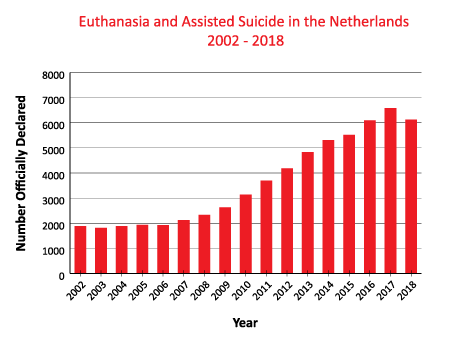
  • 6,126 deaths caused by euthanasia or assisted suicide — down 7 percent from last year’s toll — but when you consider other forms of patient eradication, such as terminal sedation (putting in a coma until the patient dehydrates to death), about 25 percent of deaths in the Netherlands are “induced.”
  • 67 patients were killed by psychiatrists and other doctors for mental illness. (The statistics don’t reveal how many of these were harvested for their organs afterward, an ongoing feature of Dutch euthanasia killings when the patient has “good” organs.)
  • Three children between the ages of 12 and 17 were put down.
  • There were 205 cases of homicide by doctors as a supposed treatment for two or more “elderly disorders,”i.e. issues such as hearing loss, balance issues, cognitive decline, etc.

Once euthanasia consciousness grabs a culture by the throat, it never stops squeezing.

UN Committee prevents disabled man from being dehydrated to death in France.

Alex Schadenberg
Executive Director – Euthanasia Prevention Coalition

Vincent Lambert’s mother has been fighting for his life.

The United Nations committee on disability rights is intervening in the Vincent Lambert case in France. 

Lambert was cognitively disabled in a motorcycle accident injury in 2008. In 2015, his wife petitioned the court to have all treatment and care ceased including food and water. His parents urged that their son be transferred to a rehabilitation center. The legal battle concerning withdrawing fluids and food from Lambert has continued. 

According to France24.com, the French government responded to the UN disability rights committee by suspending any decision to withdraw fluids and food from Lambert. France’s Health Minister, Agnes Buzyn stated:

…that although France would answer the committee, it was not under any legal requirement to abide by its request


“We are not legally bound by this committee, but of course we will take into account what the UN says, and we will respond,” she told BFMTV on Sunday.

Vincent Lambert is a man with disabilities, who is not dying or nearing death. To intentionally kill a person by withdrawing fluids, when the person is not otherwise dying is euthanasia by dehydration since the person is directly and intentionally dies of thirst.

Recently a UN disability rights envoy urged Canada to amend its euthanasia law to ensure protections for people with disabilities from euthanasia.
 

Link to previous Vincent Lambert case articles.

Euthanasia drops by 7% in the Netherlands in 2018.

By Richard Egan, researcher with the Australian Care Alliance  

The latest annual report on euthanasia and assisted suicide from the Netherlands shows that in 2018 the number of reported deaths by euthanasia decreased – for the first time since legalisation – to 6126 (a 7% decrease from 6585 cases in 2017).

Dutch deaths by euthanasia for 2018 include nine couples euthanased together; two persons with advanced dementia based on an advanced request; 205 elderly people with two or more problems of old age; 67 people with mental illness, including 10 aged between 18 and 40 years; and three children aged between 12 and 17.
 
This represents 4% of all deaths in the Netherlands in 2018.

This data relates only to officially reported cases of euthanasia and assisted suicide. A more comprehensive picture is provided by the five yearly surveys by Statistics Netherlands on all deaths by “medical end-of-life decision”. The latest data reports on all deaths in the Netherlands in 2015.

In that year there were 7254 deaths caused intentionally by lethal medication – 6672 deaths by euthanasia with a request; 431 deaths by euthanasia with no explicit request; and 150 deaths by assisted suicide.

This represents nearly 1 in 20 (4.93%) of all deaths in the Netherlands.

More than 1 in 10 (10.5%) of all deaths (other than sudden and expected deaths) of 17-65 year olds in the Netherlands in 2015 were caused intentionally by euthanasia or assisted suicide.

For assisted suicide in the Netherlands the doctor is required to be present until death occurs. Attempts at assisted suicide regularly fail to bring about death in the desired timeframe. In these cases, under the Netherlands protocols, the doctor then administers euthanasia drugs. This occurred in between 7% and 13% of cases of assisted suicide in the years 2014 to 2018.

There were 67 cases in 2018 of euthanasia for psychiatric conditions, ten of these cases involved persons aged between 18 and 40 years.
 

There were 205 cases of euthanasia in 2018 for “a stack of old age disorders” such as vision, hearing disorders, osteoporosis, osteoarthritis, balance problems and cognitive decline. Of these cases 66 involved persons under 90 years of age. The remaining 139 cases accounted for 27.15% of all cases of euthanasia of persons aged 90 years or more.

A further three minors were euthanased bringing the total to fifteen children aged between 12 and 17 years euthanased between 2005 and 2018.

In 2018 nine couples were euthanased together. Case reports are available for one of these couples. The husband had oesophageal cancer. The wife had multiple sclerosis. Her reason for requesting euthanasia at the same time as her husband was “the prospect of having to be cared for entirely by strangers and unable to continue living independently”. While the case reports note that “In the event that partners make a request for euthanasia at the same time, it must be established that the request of one partner has not been influenced or has been prompted by that of the other partner” there is no discussion in the case report on the wife of any efforts being made to explore her fears of being cared for by others.

For a detailed report on seventeen years of legalised euthanasia in the Netherlands read here.

Magazine article promotes euthanasia for people with dementia.

Alex Schadenberg
Executive Director – Euthanasia Prevention Coalition
 

There is a concerted campaign led by Canada’s euthanasia lobby to extend euthanasia to people with dementia, who previously expressed a wish to die by euthanasia. Audrey Parker died on November 1, 2018 as part of a DWD campaign to promote euthanasia for incompetent people (Link to the article).

An article in MacLean’s Magazine fits the discription of an advocacy article. The article by Shannon Proudfoot titled: For people with dementia, a fight for the right to die, focuses on Ron Posno, from London Ontario, who was diagnosed with mild cognitive impairment, which leads to dementia and Jim Mann from Surrey BC who opposes euthanasia for people with dementia. Posno’s story is presented:

Ron Posno was diagnosed with mild cognitive impairment—a precursor to dementia—in 2016, and soon after, the London, Ont., resident re-wrote his will. He already had a Do Not Resuscitate order in place, and to this he added instructions for the niece who was his substitute decision maker that at a specific point in the progress of his illness, she was to seek medical assistance in dying on his behalf.

The article does not offer balance on the issue but rather it promotes the legalization of euthanasia for incompetent people and undercuts the opposing view presented by Mann.

The article also ignores the story in the Netherlands proving that euthanasia for dementia is not always voluntary. In 2016, a 74-year-old woman with dementia died by euthanasia, even though she resisted. The woman had requested euthanasia, when she was competent, but the doctor lethally injected the woman, even after the woman said NO and resisted by secretly putting a sedative in her coffee and then asking relatives to hold her down as she was lethally injected. (Link to the article).

Posno, who is a Dying with Dignity volunteer, claims to learn that euthanasia for people with dementia is not “legal” in Canada. Posno responds:

“I am declining. My mind, literally, is being destroyed on a daily basis. There’s nothing I can do about it, there’s nothing anybody can do about it… It’s just disappearing,” the 79-year-old says. “I do not want to live like that. I don’t want to do it, I don’t want to inflict it upon the people who care for me.”…

MAID is “likely the most compelling piece of health legislation” Canada has crafted in decades, he says, “And yet it fails, and it fails primarily because it discriminates against people with dementia.” Posno has spent the last year waging a vocal campaign of advocacy and agitation against what he sees as a galling infringement on the rights of people with dementia.

The article undercuts the opposition by the Canadian Alzheimer Society to euthanasia for incompetent people when quoting Pauline Tardiff, the group’s current executive director, who states:

“When I arrived at the Alzheimer Society a few years ago, it’s the first question I asked: ‘How did we come up with this and why did we end up there?’” says Pauline Tardif, who took over as CEO in the spring of 2017. “It can be perceived in a negative way as non-supportive of people who may want to self-advocate or have authority over their affairs right to the end of life. For the same reason Ron is questioning it…I had the same question.

Like all good advocacy pieces, the author attempts to provide a voice from the other side of the debate. Proudfoot presents Jim Mann. Proudfoot writes:

As his mother’s illness progressed, they would often sit in the lounge of her long-term care facility and watch the show through the south-facing windows. Planes took off and landed at a nearby airport, and while his mom called them “the bus,” Mann knew exactly what she meant and it was a shared experience they delighted in. The landscape bloomed into life in the spring and took on a burnished palette in the fall, and they soaked it all in together. “That was joy,” he says. “I like to think you can still bend over and smell a rose; you might not know what it is, but the smell is lovely. Why miss out on that? I just wouldn’t want to.”

Instead of respecting Mann’s position, Proudfoot undercuts Mann by imposing Posno’s comments in response:

“I can talk to you, I can sing songs. You can keep me busy all day colouring a colouring book, I can go to bed every night with a teddy bear. That’s what they do!” he says, his voice leaping an octave in outraged horror. “That’s what’s considered a normal, happy life for a person in that last terminal [stage].”

“My mind will not have changed; my mind has disappeared. They have no right to say I’m happy and I deserve to live. I am not living at that point, I am existing,” he says. “Your life is in your mind, and when your mind goes, you are not alive.”

Posno’s language suggests that people with dementia are not alive. These comments are very dangerous because they dehumanize a segment of the human population. History shows us that it is much easier to kill people who have been dehumanized.

The problem remains, once euthanasia is legal, the only remaining question is who can be killed?

Euthanasia cannot be controlled because there is always a compelling reason to kill people at the most vulnerable time of their life.

Oregon Bill HB 2217 greases the slippery slope from assisted suicide to euthanasia.

Written submission of Richard M. Doerflinger

To: Members, Oregon Senate

Re: Opposition to HB 2217 on “death with dignity”

Oregon Senate

May 2, 2019


I have analyzed legislative proposals on end-of-life issues for almost four decades, and I now live in Washington state which, like Oregon, has a law allowing “death with dignity.” HB 2217 would change Oregon law to more closely adhere to the wording of Washington’s 2008 law, requiring that the lethal dose be “self-administered” by the patient.

Requiring that the patient must “self-administer” the lethal drugs seems at first glance to be a new safeguard against lethal action by third parties – that is, against allowing assistance in suicide to blur over into homicide. But this first impression is extremely misleading.

As introduced, HB 2217 defined “self-administer” as “a qualified patient’s physical act of ingesting or delivering by another method medication to end his or her life in a humane and dignified manner” [amending 127.800]. (The Washington law also defines “self-administer” in terms of “ingesting.”) But dictionaries define “ingest” as “take (food, drink, or another substance) into the body by swallowing or absorbing it” (Oxford), “take in for or as if for digestion” (Merriam-Webster), “take food or drink into the body” (MacMillan). A common synonym is “swallow.” This is something passive, a way of receiving the drugs; it is not inconsistent with someone else placing or forcing the drugs into the patient’s body.

In a House committee, HB 2217 was amended so that “self-administer” means “a qualified patient’s affirmative, conscious and voluntary act to take into his or her body medication to end his or her life in a humane and dignified manner” (emphasis added). This only repeats the problem, since dictionaries define “ingesting” as “taking” a substance “into” one’s body as by swallowing it. (The original phrase about “delivering” the drugs by another method has been deleted, leaving “self-administer” to mean only swallowing or absorbing.)

Current Oregon law refers to the patient as “taking” the lethal drugs. For example, the patient request form has the patient sign a statement that “I understand the full import of this request and I expect to die when I take the medication to be prescribed” [127.897]. This was always ambiguous: Did it mean the patient simply “takes” the drugs into his or her body, as by swallowing? Or did it mean that the patient will be the only person engaged in introducing the drugs into his or her body? HB 2217 resolves the ambiguity in the direction of the former option: Anyone can provide the drugs, introduce them into the body, even insert them into the patient’s mouth; the patient need only “take them into” his or her body by swallowing or absorbing them.

The subheading of HB 2217 says that it “prohibits anyone other than patient from administering medication to end patient’s life in humane and dignified manner.” The opposite is the case. The bill contains no such prohibition, and certainly no penalties for doing such a thing. It takes the already ambiguous term “take” in current law, and changes it to refer only to “taking into one’s body” drugs that may be administered by anyone.

One might imagine that such involvement by others is prevented by the existing Oregon law’s rule of construction stating: “Nothing in 127.800 to 127.897 shall be construed to authorize a physician or any other person to end a patient’s life by lethal injection, mercy killing or active euthanasia. Actions taken in accordance with ORS 127.800 to 127.897 shall not, for any purpose, constitute suicide, assisted suicide, mercy killing or homicide, under the law” [ORS 127.880]. But this is also not the case.

The first sentence of this provision has an unclear meaning because these terms (lethal injection, mercy killing, active euthanasia) are not defined in the Oregon law. But in any case, the second sentence nullifies the first sentence, rendering this supposed safeguard circular and meaningless. If “self-administer” means to “take into” one’s body, then the patient is “self-administering” the drugs whenever he or she receives them into the body. In such a case the practice is legal under the Death with Dignity Act, and legally cannot be construed as a case of “lethal injection, mercy killing or active euthanasia.” This circular process simply sends us back to HB 2217’s new definition of “self-administer” in 127.800 creating the loophole.

Obviously this second sentence of the provision was always meant to present a euphemism for what is really going on in “death with dignity.” That sentence also says that actions taken in accordance with the Oregon law may not be construed as “assisted suicide” – although in physical fact they are exactly what everyone calls assisted suicide, and identical with what Oregon’s own law calls the Class B felony of “assisting another person to commit suicide” (ORS 163.193) whenever the victim falls outside the definitions of the Death with Dignity Act.

In short, the new definition in HB 2217 only seems to help ensure that people who actively help kill the patient will have a “safe harbor” from prosecution. As long as it is the patient who absorbs the drugs, those who took the patient’s life can claim that they were “self-administered.”

Perhaps it is a back-handed compliment to more traditional views against homicide that when legislators seek to authorize it, they feel more comfortable doing so by euphemism and misdirection. But we should all be candid about what is going on. HB 2217 greases the slippery slope from assisted suicide to homicide.


Richard M. Doerflinger is an Associate Scholar, Charlotte Lozier Institute; Vita Faculty Fellow, University of Notre Dame’s de Nicola Center for Ethics and Culture; Public Policy Fellow, National Catholic Bioethics Center 

Death by Organ Donation – Euthanizing patients for organs.

Alex Schadenberg
Executive Director – Euthanasia Prevention Coalition

Dr E Wesley Ely

E. Wesley Ely, who, among his other professional accolades, holds The Grant W. Liddle Chair in Medicine at Vanderbilt University Medical Center, wrote an insightful article that was published in the USA Today (today) titled: Death by organ donation: Euthanizing patients for their organs gains frightening traction.


Dr Ely has written his article from the point of view of a former co-director of Vanderbilt University’s lung transplant program and a practicing intensive care unit physician. His article is a response to presentations made at International medical conferences concerning organ donation and euthanasia and the ethical debate concerning euthanasia by organ donation. Ely writes:

At international medical conferences in 2018 and 2019, I listened as hundreds of transplant and critical care physicians discussed “donation after death.” This refers to the rapidly expanding scenario in Canada and some Western European countries whereby a person dies by euthanasia, with a legalized lethal injection that she or he requested, and the body is then operated on to retrieve organs for donation. 

At each meeting, the conversation unexpectedly shifted to an emerging question of “death by donation” — in other words, ending a people’s lives with their informed consent by taking them to the operating room and, under general anesthesia, opening their chest and abdomen surgically while they are still alive to remove vital organs for transplantation into other people. 

The big deal here is that death by donation would bypass the long-honored dead donor rule, which forbids removal of vital organs until the donor is declared dead. Death by donation would, at present, be considered homicide to end a life by taking organs.

Ely, who opposes euthanasia by organ donation, explains how euthanasia by organ donation would work.

The mechanics of obtaining organs after death from either euthanasia or natural cardiac death (both already legalized in Canada, Belgium and Netherlands) can be suboptimal for the person receiving the transplant, because damage occurs to organs by absence of blood flow during the 5 to 10 minutes-long dying process. This interval is called ischemia time. Death by donation purports to offer a novel solution. Instead of retrieving organs after death, organ removal would be done while organs are still being receiving blood. There would be no ischemia time and organ removal would be the direct and proximate cause of death.

If you think that euthanasia by organ donation is not a threat, Dr Ely explains:

Recently, the New England Journal of Medicine (NEJM) published an article by two Canadian physicians and an ethicist from Harvard Medical School, who contended it might be ethically preferable to ignore the dead donor rule if patients declare they want to die in order to donate their organs.

Dr Ely then argues that society should oppose euthanasia.

According to a 2015 article in the NEJM, of the 3,882 deaths due to physician-assisted suicide or euthanasia in Flanders, Belgium, in the year 2013 alone, 1,047 (27%) were due to medication dosages to hasten death without patients’ consent. Such patients are generally unconscious and may or may not have family members around.

In 2014, a statement on end-of-life decisions by the Belgian Society of Intensive Care Medicine asserts that “shortening the dying process” should be permissible “with use of medication … even in absence of discomfort.” When discussing these facts, two prominent physicians, one from the Netherlands and another from Harvard, told me that where they come from, they call that murder. 

When physicians are participating in a procedure designed to take a person’s life, will patients feel 100% certain that their physician is firmly on the side of healing? What message does it send about the value of every human life when physicians endorse the exchange of one life for another? What affect has it already had on physicians complicit in such death-causing procedures?

Finally Dr Ely compares the discussion about euthanasia to the 1973 movie Soylent Green.

In the 1973 science fiction classic “Soylent Green,” detective Frank Thorn searches for answers to dying oceans and a deteriorating human race on overcrowded Earth. He discovers the high-protein green food produced by the Soylent Corporation is recycled, euthanized humans. “Soylent Green is people!” he screams. 

“Soylent Green” was set in 2022. We are three years away.

Dr E. Wesley Ely is building awareness with the discussion and concerns with euthanasia by organ donation.

Sadly, once society accepts that killing can be an acceptable solution to certain human problems, then the only question is which human problems can killing be a solution for?

Once society accepts euthanasia, then it naturally follows that euthanasia by organ donation will be considered. If the issue is debated based on its efficacy, then euthanasia by organ donation will be become a reality because it is a very effective way to obtain healthy organs for transplanting.

Sigue adelante el juicio de las audioguías de la Alhambra: se han perdido 1,3 millones de euros

El Juzgado de Instrucción número 4 de Granada ha ordenado continuar la causa por el trámite del procedimiento abreviado contra la exdirectora del Patronato de la Alhambra, María del Mar Villafranca, y dos investigados más por las posibles irregularidades en la contratación de las audioguías. El juez da así por finalizada la instrucción y considera que se pueden haber cometido delitos de prevaricación administrativa, malversación de caudales públicos, apropiación indebida y blanqueo de capitales. Da diez días de plazo al Ministerio Fiscal y a las acusaciones personadas para que formulen escrito de acusación o soliciten el archivo de la causa.

Además de la exdirectora del Patronato de la Alhambra, también continúan como investigados la exsecretaria general de la Alhambra y el administrador único de la empresa a la que se adjudicó el servicio de audioguías. Por el contrario, acuerda el archivo de la causa para los cinco investigados restantes, el exjefe de la Sección Económica y Contabilidad de Ingresos en el monumento; un interventor; un empleado de la empresa adjudicataria del servicio, un funcionario y una jefa de sección.

Esta decisión se produce después de que la Fiscalía solicitara hace unas semanas el sobreseimiento provisional para todos ellos, alegando que no ha resultado «debidamente acreditada» su participación en los hechos que se investigan, y que el proceso continuara contra los otros tres.

El Juzgado lleva investigando desde 2015 las presuntas irregularidades cometidas en torno a la adjudicación del servicio del audioguía electrónica para uso de los visitantes individuales a la Alhambra, considerado el monumento más visitado de España, así como de un equipo receptor para los componentes de grupos organizados que accedían al recinto. El auto considera que, debido a estas irregularidades, se ha producido un perjuicio económico a la Alhambra casi 1,3 millones de euros sólo en el alquiler de equipos individuales.

El juez considera que se contrató con una empresa el servicio de audioguías con unas condiciones que más tarde cambiaron y que, después, “la prórroga del contrato fue acordada por la investigada, previas reuniones concertadas con el adjudicatario para trazar un plan que permitiera ofrecer una salida a la falta de pago de la deuda contraída con el Patronato de la Alhambra y el Generalife”, con conocimiento de la ilegalidad de dicha prórroga.

En el auto señala que la exdirectora “acuerda o consiente” la existencia de nulo control en el Conjunto Monumental “sobre la actuación, en este caso, del adjudicatario, y por otro lado la investigada ha mantenido con conocimiento y voluntad, desde el primer momento de la adjudicación del contrato, una actitud especialmente favorecedora de los intereses de Stendhal, y ha permitido y consentido que esta se apropie de caudales públicos”.

Design a site like this with WordPress.com
Get started