The New Great Game Round-Up #77

The Great Game Round-Up brings you the latest newsworthy developments regarding Central Asia and the Caucasus region. We document the struggle for influence, power, hegemony and profits between a U.S.-dominated NATO, its GCC proxies, Russia, China and other regional players.

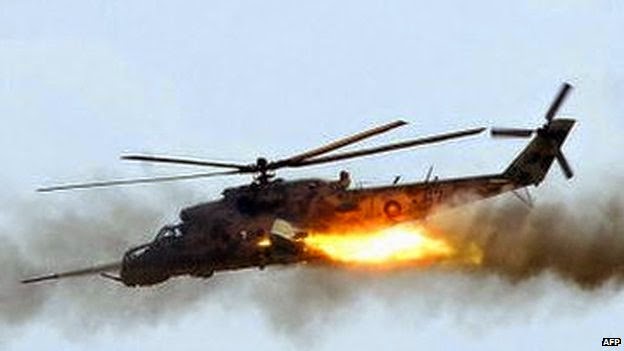
In May of this year, China launched a one-year-long no-holds-barred anti-terror campaign in its far-western Xinjiang region after a major terrorist attack had struck Xinjiang's capital Urumqi, killing 43 people and wounding more than 90. In the last six months, the Chinese authorities have been arresting everyone and his brother to stop the violence in Xinjiang, including prominent Uyghur scholar Ilham Tohti, who was sentenced to life in prison on charges of advocating separatism and inciting ethnic hatred. Western governments and media did their best to highlight Tohti's imprisonment and called repeatedly for his release, to no avail. Last week, a court in Urumqi upheld the life sentence and a few days later the same court opened separatism trials for seven of Tohti's students. While Western media criticized the latest act of Chinese repression, Chinese media lauded the results of the first six months of the anti-terror campaign. According to China's Ministry of Public Security, 115 terrorist cells were quashed and more than 300 suspects detained. But only a few days after the ministry released its report, another terrorist attack reminded everyone that the violence continues:

15 killed, 14 injured in Xinjiang terrorist attack

Fifteen people, including 11 mobsters, were killed and 14 people were injured in a terrorist attack in Shache County on Friday afternoon in northwest China's Xinjiang Uygur Autonomous Region, local authorities announced in a statement on Saturday.

The mobsters threw out explosive devices and attacked civilians with knives at a food street in the county around 1:30 p.m. on Friday. Police patrolling nearby killed 11 of them.

A number of explosive devices, knives and axes were found at the scene.
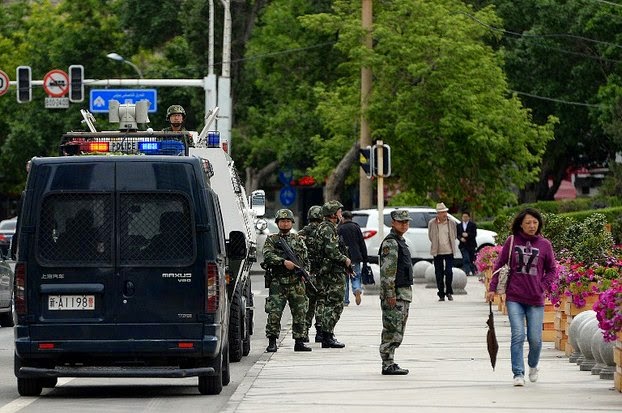
© Photo AFP

Read more

The New Great Game Round-Up #76

The Great Game Round-Up brings you the latest newsworthy developments regarding Central Asia and the Caucasus region. We document the struggle for influence, power, hegemony and profits between a U.S.-dominated NATO, its GCC proxies, Russia, China and other regional players.

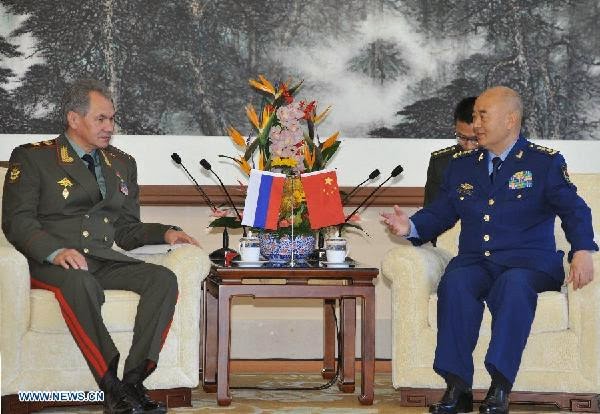
So-called color revolutions have long been used by the United States to replace governments all over the world with more pliable alternatives if the respective leaders have outlived their usefulness or antagonized Washington, the most recent example being the Euromaidan in Ukraine. After Ukrainian President Viktor Yanukovych refused to sign an Association Agreement with the European Union, the U.S. and its allies launched Orange Revolution 2.0 to ensure Kiev's commitment to Euro-Atlantic integration and to nip Ukraine's accession to the Russia-led Eurasian Economic Union (EEU) in the bud. On November 21, Ukrainians gathered in Kiev to mark the first anniversary of the start of the fateful anti-government protests, which have plunged the country into war, leading to a new confrontation between Russia and the West. In light of the developments in Ukraine, many governments are increasingly alarmed at color revolutions. Especially Russian officials have been repeatedly warning against this “new form of warfare” in recent months. A few days ago, President Putin urged Russian security chief to do everything necessary to prevent a color revolution in Russia and the issue was also high on the agenda during this week's talks between Russian and Chinese defense ministers:

Russia, China should jointly counter “color revolutions” — Russian Defense Ministry

Russia and China should jointly stand against “color revolutions” which both countries are facing, a deputy Russian defence minister said after talks between Russian and Chinese defence chiefs on Tuesday.

“We focused on those events which have recently taken place in Hong Kong, and both ministers acknowledged that no country is immune from ‘color revolutions,’” Anatoly Antonov said.

“It only seems that these “color revolutions” and these experiments by Western spin doctors, including those from the United States, are being implemented somewhere far from China or the Russian Federation,” Antonov said. “All this is in fact near us, and we believe that Russia and China should work together to withstand this new security challenge to our countries.

© Photo Xinhua/Gao Jie

Read more

The New Great Game Round-Up #75

The Great Game Round-Up brings you the latest newsworthy developments regarding Central Asia and the Caucasus region. We document the struggle for influence, power, hegemony and profits between a U.S.-dominated NATO, its GCC proxies, Russia, China and other regional players.

Three months ago, Armenia and Azerbaijan were on the brink of all-out war after the worst clashes in years over the disputed Armenian enclave of Nagorno-Karabakh in Azerbaijan had left more than a dozen soldiers dead. Russian President Vladimir Putin brought both sides to the negotiating table to prevent a further escalation of the conflict and Azerbaijani President Ilham Aliyev readily agreed to postpone the recapture of Nagorno-Karabakh, which fueled speculation that Baku had provoked the clashes for political reasons. Azerbaijan has shown a pattern of provoking such events in order to get the international community to devote more attention to the conflict. Moreover, the escalation of violence in late July/early August coincided with a crackdown on human rights activists and NGOs. After this short period of heavy fighting the situation calmed down and last month French President Francois Hollande hosted “constructive” talks between Aliyev and his Armenian counterpart Serzh Sargsyan. The two leaders agreed to continue the dialogue to find a negotiated peace to the Karabakh conflict but this week's downing of an Armenian helicopter doesn't bode well for the shaky peace process:

Azerbaijan shoots down Armenian helicopter

The armed forces of Azerbaijan shot down and destroyed an Armenian military helicopter in the Nagorno-Karabakh region on Wednesday, the defense ministries of both countries said.

The incident threatened to set off another cycle of violence between the two South Caucasus neighbors over Nagorno-Karabakh, which is part of Azerbaijan but along with some surrounding territory has been under the control of Armenian soldiers and local Armenian forces since a 1994 cease-fire.

Nagorno-Karabakh said the helicopter belonged to its armed forces and was on a training flight near the cease-fire line. All three crew members on board were killed, a high-ranking officer with the Nagorno-Karabakh forces told the AP. The officer was speaking on condition of anonymity because he was not authorised to release the information.

Read more

The New Great Game Round-Up #74

The Great Game Round-Up brings you the latest newsworthy developments regarding Central Asia and the Caucasus region. We document the struggle for influence, power, hegemony and profits between a U.S.-dominated NATO, its GCC proxies, Russia, China and other regional players.

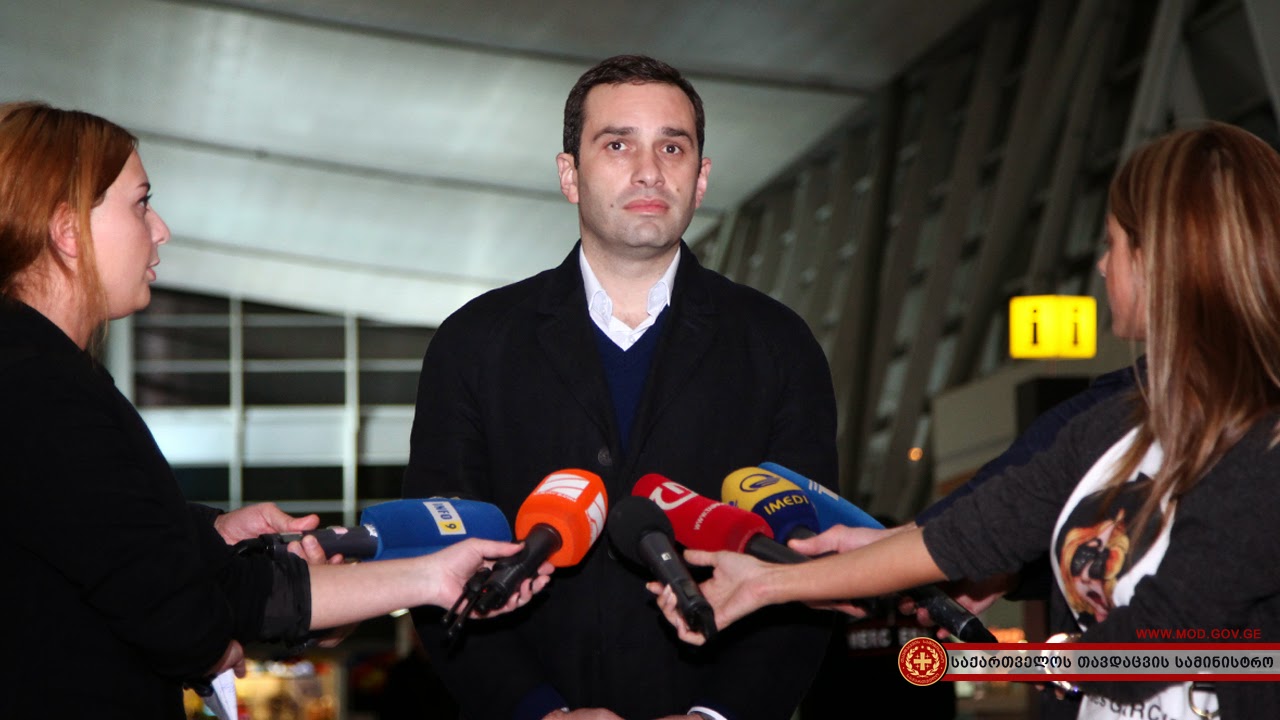
Russia's southern neighbor und staunch NATO ally Georgia has been hitting the headlines on a daily basis in recent weeks. While Georgian officials were still freaking out over Russia's “attempt to annex” Georgia's breakaway region of Abkhazia, South Ossetia, inspired by the treaty offered to its separatist twin, began to draw up a similar agreement meant to insert the disputed territory into the Russian Federation. Tbilisi tried to win back the two regions by offering them broad autonomy and to share the prospective benefits of Georgia’s integration with the EU, but to no avail. To make matters worse, the Georgian government didn't even have the time to comprehend that Georgia is about to lose Abkhazia and South Ossetia once and for all because the country is facing yet another crisis. It all started with the arrest of five former and current officials of the Defense Ministry and general staff of the armed forces, who are accused of contract-rigging and thereby defrauding the state of $2.34 million. Defense Minister Irakli Alasania, who was visiting France and Germany at the time, got behind the detained officals and condemned the arrests in the strongest possible terms after his return:

Georgia: Defense Minister Claims NATO Plans under Threat

Georgia’s NATO-membership plans have come under attack from within the the country's government itself, embattled Georgian Defense Minister Irakli Alasania claimed on November 4, as a crisis over investigations into his ministry deepens within the ruling coalition.

Alasania, rated as Georgia’s favorite political figure, declared in a televised briefing that prosecutors’ sudden spate of inquiries into the defense ministry’s work is politically motivated. After the arrest of five former and current ministry officials last week as part of a probe into a tender, prosecutors today filed criminal charges against three army medical officers in a food-poisoning case.

“This is an attack on Georgia’s Euro-Atlantic choice. This is an attack on the agency with an outstanding record in achieving our foreign policy goals,” Alasania asserted. “I will not be intimidated by the prosecutors or by mud-slinging by certain media groups,” he added.

© Photo Georgian Ministry of Defense

Read more

The New Great Game Round-Up #73

The Great Game Round-Up brings you the latest newsworthy developments regarding Central Asia and the Caucasus region. We document the struggle for influence, power, hegemony and profits between a U.S.-dominated NATO, its GCC proxies, Russia, China and other regional players.

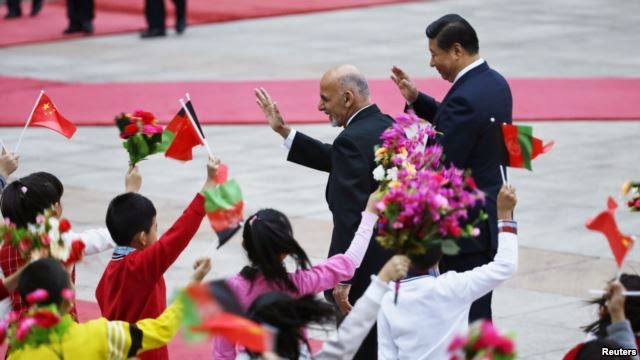
After performing a pilgrimage to Mecca and holding talks with King Abdullah and other high-level Saudi officials on his first foreign trip since since taking office in September, Afghanistan's newly selected president Ashraf Ghani travelled to China for an important four-day visit aimed at strengthening ties between the two neighboring countries. As the NATO-led forces are reducing their presence in Afghanistan, Kabul is looking east for foreign investment while Beijing is trying to ensure stability in the region. On the first day of his visit, Ghani met with Chinese President Xi Jinping, who called for “a new era of cooperation in China-Afghanistan relations.” The two leaders agreed on a new long-term partnership and given that Beijing is alarmed at the prospect of a failed state or a civil war right on China's doorstep, Ghani didn't have a hard time in securing some desperately needed investments:

China Pledges $327 Million in Aid to Afghanistan

China has pledged two billion yuan ($327 million) in aid to Afghanistan, which is seeking new sources of foreign help amid a drawdown of U.S. troops and increasing worries about regional instability.

The offer of aid through 2017 came after China’s President Xi Jinping and newly elected Afghan President Ashraf Ghani met in Beijing on Tuesday, according to a joint declaration published Wednesday by China’s foreign ministry. Beijing and Kabul also agreed to step up intelligence sharing to fight drug trafficking and address other cross-border issues.

Read more

Porkins Great Game: Episode #2 – Crisis in the Caucasus and Mysterious Crashes

On this edition of Porkins Great Game, Pearse Redmond and I discuss briefly the appointment of Jens Stoltenberg as new Secretary General of NATO before we move on to the conflicts brewing in the Caucasus region. We talk about the significance of this month's suicide bombing in the Chechen capital Grozny as well as Russia's “attempt to annex” Georgia's breakaway region of Abkhazia. Later we also take a look at the mysterious crashes of Total CEO Christophe de Margerie and Press TV reporter Serena Shim before we close out with a humorous look at CIA (and Gladio B) operative Graham Fuller’s futile attempts to change his public image by way of the Huffington Post.

Read more

The New Great Game Round-Up #72

The Great Game Round-Up brings you the latest newsworthy developments regarding Central Asia and the Caucasus region. We document the struggle for influence, power, hegemony and profits between a U.S.-dominated NATO, its GCC proxies, Russia, China and other regional players.

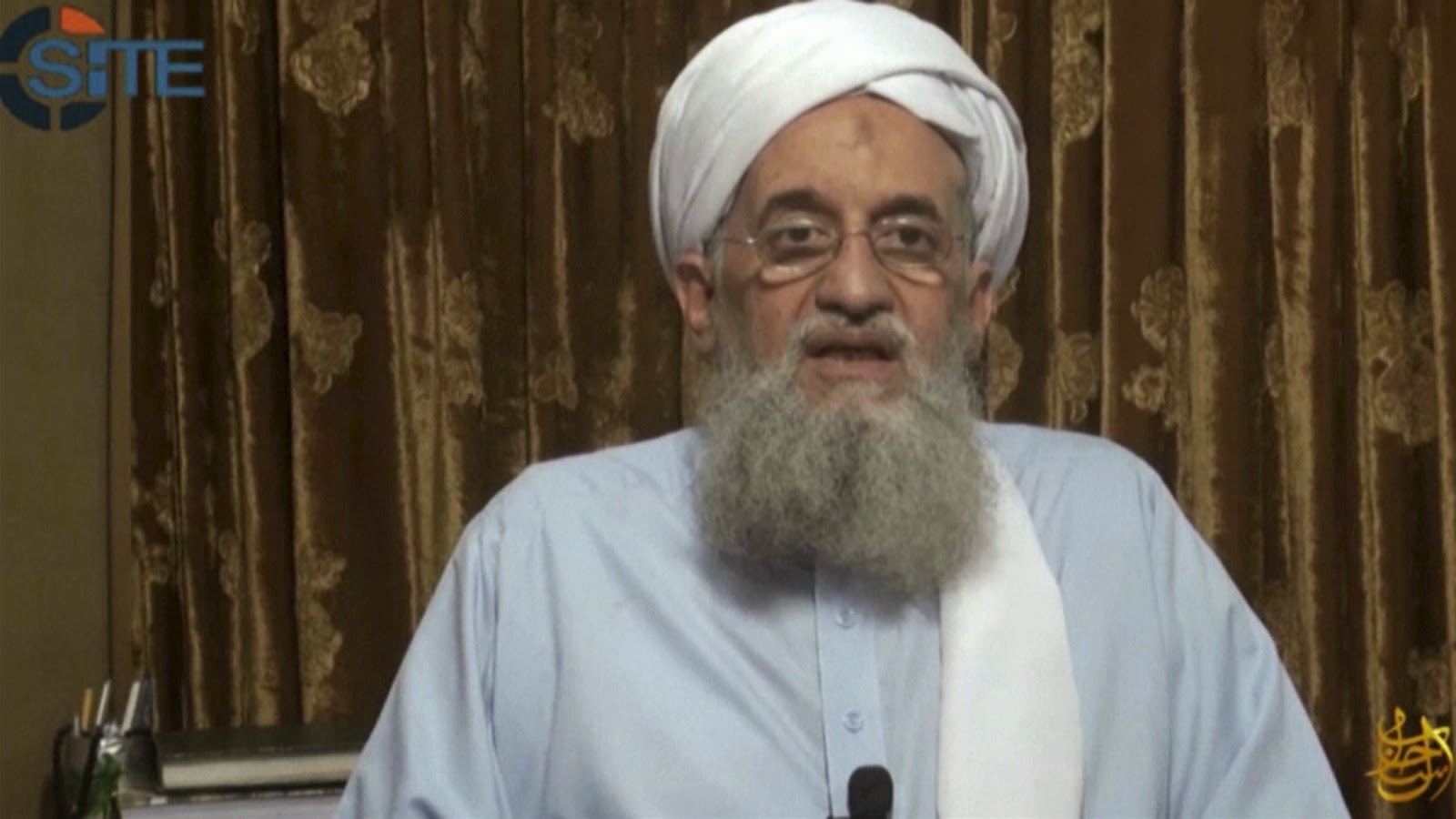
Every day, the new star in the world of takfiri terrorist groups, the Islamic State aka ISIL aka ISIS aka Da'ish, is dominating the headlines. Western media is eager to highlight every atrocity committed by ISIS while similar crimes committed by the “moderate Syrian rebels” have been swept under the rug for years and are still being ignored. The “Syrian rebels” used chemical weapons?! No, that is completely inconceivable. ISIS used chemical weapons?! Yes, that goes without saying. Although the Kurds exposed the new darling of Western media as “the most overhyped military force on the planet” during the siege of Kobane, there is no end in sight to the ISIS hype, much to the dismay of the previous number one boogeyman al-Qaeda. The organization of U.S./NATO puppet Ayman al-Zawahiri is desperately trying to get some attention. Last month, Zawahiri released one of his dubious videos announcing the establishment of a new branch on the Indian subcontinent and lately the group threatened China, stressing that Xinjiang needs to be “recovered [into] the shade of the Islamic Caliphate”:

Al-Qaeda Declares War on China, Too

Al-Qaeda central appears to have joined the Islamic State in calling for jihad against China over its alleged occupation of Xinjiang Uyghur Autonomous Region.

This week, al-Sahab media organization, al-Qaeda’s propaganda arm, released the first issue of its new English-language magazine Resurgence. The magazine has a strong focus on the Asia-Pacific in general, with feature articles on both India and Bangladesh, as well as others on Afghanistan and Pakistan.

However, the first issue also contains an article entitled “10 Facts About East Turkistan,” which refers to the name given to Xinjiang by those who favor independence from China. The ten facts seek to cast Xinjiang as a longtime independent state that has only recently been brutally colonized by Han Chinese, who are determined to obliterate its Islamic heritage.

Read more

The New Great Game Round-Up #71

The Great Game Round-Up brings you the latest newsworthy developments regarding Central Asia and the Caucasus region. We document the struggle for influence, power, hegemony and profits between a U.S.-dominated NATO, its GCC proxies, Russia, China and other regional players.

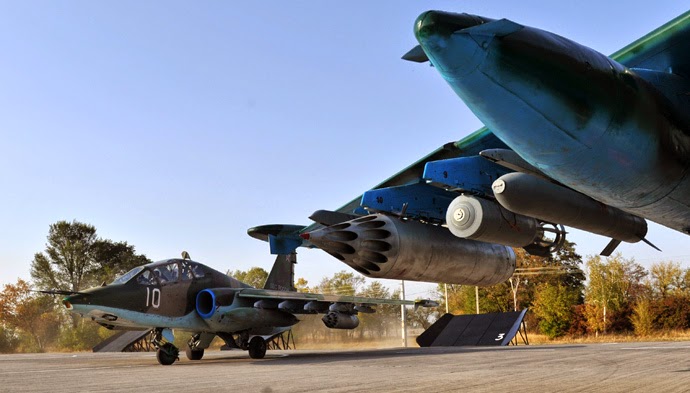
Much to the dismay of the United States, Russia “has been steadily strengthening its foothold” in Kyrgyzstan in recent years. This became apparent in June of this year, when American troops vacated the important U.S. air base at Manas International Airport after the Kyrgyz government had yielded to Russian pressure and agreed to kick the Americans out. Since 2001, the U.S. had used Manas not only to support U.S. military operations in Afghanistan, but also to engage in all kinds of nefarious activities. After years of unsuccessful attempts to convince Bishkek of closing the base, the Russians finally got their way a few months ago, marking “Kyrgyzstan’s new era as a Russian client state” according to Alexander Cooley, Deputy Director for Social Sciences Programming at Columbia University's Harriman Institute, which is famous for its anti-Russian bias. Cooley's statement shows that the closure of Manas was a heavy blow for the United States. Moscow lost no time in capitalizing on the departure of U.S. forces and is now apparently planning to expand Kant Air Base in Kyrgyzstan as well as its base in Armenia [emphasis mine]:

Russia Strengthens Air Defenses With Bases in Belarus and Central Asia

As Moscow moves to bolster its military presence in ex-Soviet allied states, the head of the Russian air force announced that Russia will establish an airbase for fighter jets in eastern Belarus in 2016, state media outlets reported Wednesday.

Colonel General Viktor Bondarev also said Moscow planned to expand its airbases in Armenia and Kyrgyzstan.

The three nations are members of a loose Russia-dominated security alliance known as the Collective Security Treaty Organization (CSTO), which has accelerated efforts to create a unified air defense network as the Ukraine crisis reenergizes the West's military powerhouse, NATO.

© Photo AFP/Vyacheslav Oseledko

Read more

The New Great Game Round-Up #70

The Great Game Round-Up brings you the latest newsworthy developments regarding Central Asia and the Caucasus region. We document the struggle for influence, power, hegemony and profits between a U.S.-dominated NATO, its GCC proxies, Russia, China and other regional players.

After nearly four years of negotiations, the European Union und Kazakhstan finally agreed on a new enhanced Partnership and Cooperation Agreement (PCA) during this week's visit to Brussels by Kazakh President Nursultan Nazarbayev. The agreement, which is expected to be signed next year, “aims to boost cooperation in around 30 policy areas including trade and foreign and security policy.” Given that the PCA is a far weaker deal than the infamous European Union Association Agreement and that the Kazakh negotiators had been “very careful that the agreement respects their country's commitments to the Customs Union and the Eurasian Economic Union,” the Kremlin won't get worked up over the agreement. With the PCA negotiations concluded, Nazarbayev travelled to Minsk to attend summits of the Commonwealth of Independent States, the Eurasian Economic Community and, most importantly, the Eurasian Economic Union, which welcomed a new member:

Armenia Joins Eurasian Union

After months of delay, Armenia formally joined the Eurasian Economic Union (EEU) of Russia, Belarus and Kazakhstan on Friday, drawing praise from Russian President Vladimir Putin.

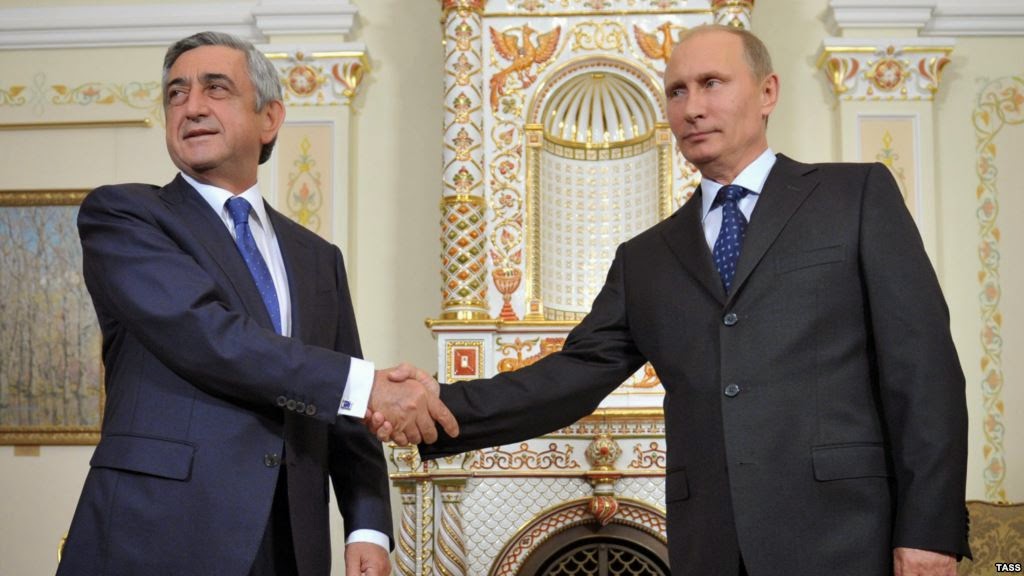
President Serzh Sarkisian signed a corresponding accession treaty with Putin and Presidents Nursultan Nazarbayev of Kazakhstan and Aleksandr Lukashenko of Belarus at a summit of the Russian-led bloc held in Minsk.

Speaking at the gathering, both Putin and Sarkisian expressed hope that the treaty will be ratified by the parliaments of the EEU’s three member states by the end of this year. The Armenian president said his country should be able to “start working from January 1” as a full-fledged member of an alliance which critics fear will restore Russian hegemony over much of the former Soviet Union.

Read more

The New Great Game Round-Up #69

The Great Game Round-Up brings you the latest newsworthy developments regarding Central Asia and the Caucasus region. We document the struggle for influence, power, hegemony and profits between a U.S.-dominated NATO, its GCC proxies, Russia, China and other regional players.

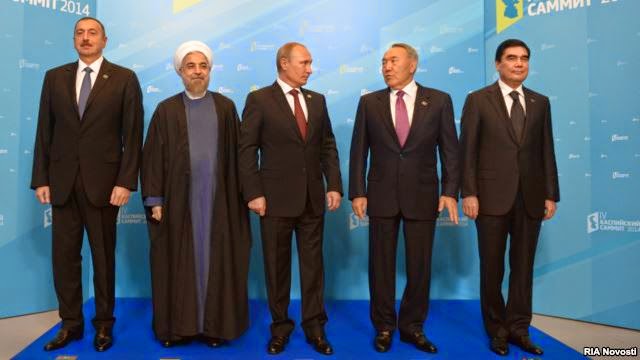
At the beginning of this week, the presidents of the five Caspian littoral states gathered in the Russian city of Astrakhan to attend the fourth Caspian Summit. Since the collapse of the Soviet Union, the question of how the Caspian shelf should be divided has been dispute and although Azerbaijan, Iran, Kazakhstan, Russia and Turkmenistan made some progress at the recent summit, they remain divided on this key issue. While Russian President Vladimir Putin and his Kazakh counterpart Nursultan Nazarbajev were talking about a “breakthrough”, Turkmenistan's leader Gurbanguly Berdimuhamedow reminded everyone of the disagreements when he reiterated that “Turkmenistan believes that the construction of pipelines under the Caspian Sea is the sovereign right of the states through whose section of the seafloor they pass.” Berdimuhamedow was of course referring to the construction of the Trans-Caspian Gas Pipeline, which is vehemently opposed by Russia and Iran. Moscow and Tehran will have a hard time convincing Berdimuhamedow and Azerbaijani leader Ilham Aliyev to give up on this pipe dream but they accomplished another important objective in Astrakhan:

Russia and Iran Lock NATO Out of Caspian Sea

Iran and Russia have built unanimous consensus among the Caspian states, which also feature Azerbaijan, Kazakhstan and Turkmenistan, over the inadmissibility of a foreign military presence in the Caspian Sea, ruling out any future possible deployment of NATO forces in the basin.

A political declaration signed by the presidents of the five Caspian states at the IV Caspian Summit held in Astrakhan, Russia, on September 29, “sets out a fundamental principle for guaranteeing stability and security, namely, that only the Caspian littoral states have the right to have their armed forces present on the Caspian,” according to a statement by Russian President Vladimir Putin in the wake of the summit.

Read more

Design a site like this with WordPress.com
Get started