Science & Technology: Innovative Drilling Company Provides an Update – Video

HyperSciences – Shell Demo Winter 2019 (HyperSciences)

(Video 2:26 Minutes)

From the HyperSciences website: HyperDrill™ is our oil & gas and geothermal drilling solution. With financial commitment by one of the world’s largest upstream oil & gas companies we have developed a drilling solution that increases rate of penetration by up to 10x that of existing drilling technology. Funded and Sponsored by Shell Game Changers for 2+ years.

Our Geothermal solution leverages the performance benefits of HyperDrill, the ability to reach deep geothermal energy deposits, and our patent-pending thermoelectric power generation technology to provide cost-effective and scalable clean energy in the measure of MegaWatts.

From the Global Geothermal News archives:

Geothermal Event! Call For Papers – Special Topic Sessions Announced

GRC Call For Papers – Draft Paper Submissions Due: May 27, 2020 (News Release)

The Geothermal Resources Council (GRC) invites you to present your latest technical work in geothermal research, exploration, policy, development and utilization at GRC’s 44th Annual Meeting & Expo.

Continuing with the success of special topic sessions from the last couple of years, listed below are the special topic sessions for the 2020Reno conference:

  • 2018 Kilauea Volcano Eruption and Geothermal Reservoir
  • Advanced Materials for Drilling, Completion and Monitoring
  • District Heating and Direct Use: Feasibility to Implementation
  • EGS Collab : Experimentation, Modeling and Interpretation
  • FORGE Activities, Progress and Plans
  • Geochemistry for Early Geothermal Exploration
  • Geomechanics in Geothermal
  • Geothermal Energy in Canada: Moving Forward
  • Geothermal Heat pumps: Latest Tech & Market Development
  • High Temperature Reservoir Monitoring Systems
  • Machine Learning in Geothermal Development
  • Mineral Extraction
  • Power Plant Improvement Strategies
  • Reservoir Closed Loop and Energy Transfer Systems
  • Super Hot/Supercritical Geothermal Systems

Other general topics sessions are also available for authors to submit draft papers to.

International participation is an important part of the success of the GRC Annual Meeting technical programs and we encourage geothermal researchers and experts from the USA and around the world to submit their work for consideration to be presented at the GRC Reno2020.

Learn more………..

Germany: High Hopes for New Geothermal Energy Project in Baden-Württemberg

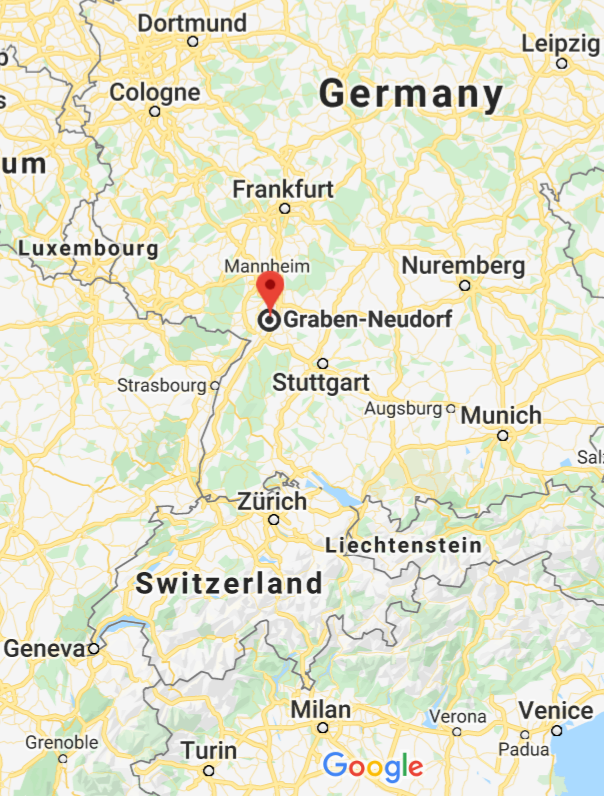
Deutsche Erdwärme hält Bedingungen für Geothermie bei Graben-Neudorf für einzigartig – Deutschen Erdwärme considers conditions for geothermal energy at Graben-Neudorf unique (Badische Neueste Nachrichten)

„Die Bedingungen vor Ort sind einmalig für ganz Europa“, sagt Herbert Pohl, Geschäftsführer der Deutschen Erdwärme. Das Karlsruher Unternehmen, das zurzeit vor allem im Südwesten Deutschlands agiert, ist überzeugt von der erfolgreichen Energiegewinnung durch heißes Thermalwasser aus der Tiefe.

(From Google translate) “The local conditions are unique for all of Europe,” says Herbert Pohl, Managing Director of Deutsche Erdwärme. The Karlsruhe company, which currently operates primarily in southwestern Germany, is convinced of the successful energy generation from hot thermal water from below.

Weiterlesen………                           Read More………

Vancouver area hospice fights death order

Sign the petition: Hospice Organizations Must NOT be Forced to do Euthanasia (Link).

Vancouver area hospice is asking the government to reconsider their proposal to give up $750,000 a year in funding so that it not be required to violate its mandate of care and compassion for patients by providing Medical Assistance in Dying (MAiD) at its facility. (Link to the original letter).

The health authority’s demand is unnecessary, the hospice contends, noting that the MAiD option is widely available at many other facilities, including one next door.


By forfeiting the government funding, the hospice would be under the 50% threshold set by the government and therefore exempt from providing MAiD.


Angelina Ireland, President of the Delta Hospice Society, said that the Society’s Charter specifically mandates it to provide compassionate care and support for persons in the last stages of living, so that they may live as fully and comfortably as possible.

“Helping and supporting patients to live fully and comfortably in their last days and giving support to them and their families is what our patients and families come to us for and expect and it is certainly what our staff are dedicated to providing. Taking steps to end a patient’s life is not providing care and support so that ‘they may live fully.’”

Fraser Health Authority ordered the Delta Hospice Society late last year to provide Medical Assistance in Dying (MAiD) claiming that failure to do so would be a breach of the Society’s agreement with the authority.

Ireland said in order to comply with the Authority’s instruction it would have to violate its legal commitments under the province’s Societies’ Act which requires them to follow their Charter. Further, DHS is not in breach of the Agreement. There is nothing in the Agreement which requires DHS to provide MAiD or allow it to be provided on its premises. The FHA is attempting to amend the Agreement by making a unilateral decision to impose an obligation, which in itself would be a contravention of the Agreement. The Fraser Health Authority’s new directive puts the Hospice Society in a difficult position of either honouring their Charter and legal obligations or acceding to what she called “an agenda-driven demand which ignores our primary function and pays no heed to the needs or wants of those patients and families we are caring for.”


The Delta Hospice Society has tried to work with the health authority, explaining the dilemma the order places upon them, outlining their function to assist patients live fully in their final days before natural death, and offering options to help settle the dispute but the Fraser Health Authority has refused to budge.


On January 15, 2020, Delta Hospice Society wrote the Fraser Health Authority to ask that they reconsider the proposal to give up the $750,000 a year in funding so that they may benefit from the exemption set out in a Ministry of Health policy.


Ireland said that giving up the funding would cause the Society to focus exclusively on their Hospice operations. The other services the Society provides to the community would be put on the back burner until alternative funding partnerships can be established. The Society is committed to continuing to provide the quality care it has provided since its founding in 1991, and protecting the Society’s mandate and organizational integrity.


Ireland noted further that there are many locations where MAiD is already available to those wishing to avail themselves of that option, including a facility next door.

“Nobody wanting such a service would be prevented access. The issue is not accessibility. It seems to be a purely agenda-driven demand that runs rough shod over both Delta Hospice Society’s desire to live up to its legal requirements under our Charter, as well as ignoring the reality that we are dealing with patients and families in a very vulnerable and delicate position.”

“Our goal,” she added, “is to fulfill our mission. And that is to help patients and their loved ones live quietly, comfortably, and as fully as possible in their final days of life.”


She reiterated the hospice’s desire to negotiate an equitable arrangement with the Fraser Health Authority to maintain Delta Hospice’s role of serving its patients well.


Contact: Angelina Ireland 778-512-8088; irelandangelina@gmail.com

Netherlands: Port of Rotterdam Geothermal Heat Project Advances

Research into the geothermal port of Rotterdam is entering the next phase (Port of Rotterdam Authority)

Shell Geothermal BV and the Port of Rotterdam Authority are jointly investigating the options for geothermal energy in the western part of the port of Rotterdam. The two companies have received an exploration permit from the Ministry of Economic Affairs for this.

In recent years, the subsurface has been well mapped out, partly as part of the UDG green deal. Obtaining the exploration permit means that Shell and the Port Authority will have time in the coming years to further develop their plan with the aim of developing geothermal heat projects in the western part of the port. Over the next two years, the emphasis will be on making agreements with potential geothermal energy buyers, working out the costs, determining a possible location for a test drilling and figuring out what the infrastructure can look like. It is also essential that geothermal heat can compete with energy from other sources. For the time being, doing a (test) drilling is not yet an issue.

Read More………..

From the Global Geothermal News archives:

USA, California: Microsoft Commits to 100% Renewable Energy by 2025

Microsoft will be carbon negative by 2030 (Blog)

By 2030 Microsoft will be carbon negative, and by 2050 Microsoft will remove from the environment all the carbon the company has emitted either directly or by electrical consumption since it was founded in 1975.

By 2025, we will shift to 100 percent supply of renewable energy, meaning that we will have power purchase agreements for green energy contracted for 100 percent of carbon emitting electricity consumed by all our data centers, buildings, and campuses.

Reducing carbon is where the world needs to go, and we recognize that it’s what our customers and employees are asking us to pursue. This is a bold bet — a moonshot — for Microsoft. And it will need to become a moonshot for the world.

It won’t be easy for Microsoft to become carbon negative by 2030. But we believe it’s the right goal. And with the right commitment, it’s an achievable goal. We will need to continue to learn and adapt, both separately and even more importantly in close collaboration with others around the world. We believe we launch this new initiative today with a well-developed plan and a clear line of sight, but we have problems to solve and technologies that need to be invented. It’s time to get to work.

Read More………

Canada poised to expand euthanasia law.

This article was published by OneNewsNows on January 17, 2020

By Charlie Butts

A spokesman for a non-profit organization that opposes euthanasia and assisted suicide says Canada has opened the gates to more death.

*Guide to answering the Canadian MAID consultation questionnaire (Link).

Alex Schadenberg

Euthanasia has been available in Canada for people with a terminal illness, but a Quebec court has now abolished the “near death” requirement.

“By removing the terminal illness requirement, that means you can have euthanasia for physical or psychological suffering,” explains Alex Schadenberg of the Euthanasia Prevention Coalition. “I do believe this situation is going to be opening up the gates to far more deaths by euthanasia. At the same time, our euthanasia numbers have just been skyrocketing. So as much as we have seen this huge increase in euthanasia, they’re only going to be opening the doors more.”

Parliament is currently conducting a consultation, considering ideas to expand the practice even further to include psychological reasons such as depression. It could even affect anyone who is no longer mentally competent to agree to euthanasia, so Schadenberg is urging people to oppose expansion during the consultation.

“The reality of this whole thing is we need to reverse this whole trend of allowing killing, because what we’ve done in law is we’ve given physicians the right to kill their patients, and we’ve done so by also granting them pretty tight immunity from ever having to worry about prosecution,” the Coalition spokesman submits.

The consultation ends January 27th, and the court has imposed a deadline of March 11th for the government to overhaul its euthanasia law.

Indiana assisted suicide bill fails to protect objecting practitioners

This article was published by the Protection of Conscience Project on January 16, 2020

Assisted suicide evolves from “assistance” to “medical care” 

Affirmation has serious consequences for objecting Indiana physicians


By Sean Murphy

Introduction

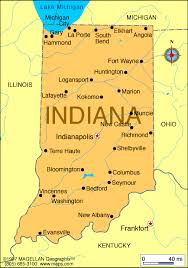
On 7 January, 2020, Representative Matt Pierce introduced HB1020: End of life options in the Indiana General Assembly.1 HB1020 is the fourth assisted suicide bill introduced by Pierce since 2017; three previous bills died in committee without hearings.2,3,4,5,6 Parts of HB1020 relevant to protection of conscience are reproduced on the Project website.7
 

Overview

The bill permits physician assisted suicide for Indiana residents 18 years of age and older who have been diagnosed with a terminal illness likely to cause death within six months. Candidates must be competent to make health care decisions and must apply in writing for a lethal prescription; the application must be witnessed by two independent witnesses. Lethal medication can be prescribed or dispensed by an attending physician after a fifteen day waiting period if the patient is acting voluntarily and making an informed decision.

Neither the attending physician nor any other person need be present when the lethal medication is taken, though the attending physician must tell the patient that someone else should be present. The lethal medication must be self-administered. If the medication does not cause death, no one is authorized to kill the patient. 
HB1020 imposes obligations upon “attending physicians”8 and “consulting physicians”9 and it assumes the cooperation of pharmacists in dispensing lethal medication. There is some ambiguity in the description of what is expected of attending physicians. Section 4(a)(13) makes provision or prescription of lethal medication an absolute obligation if all of the conditions specified in the bill are met (“. . .the attending physician shall. . .”). On the other hand, Section 4(c) seems to leave some discretion to the attending physician to refuse, even if the conditions are met (“. . . the attending physician may . . .”). A later protective provision indicates that an attending physician can refuse, but the ambiguity in the wording of Section 4 remains.

Protective provisions: biased, insufficient and conflicting

The bill makes no reference to freedom of conscience or religion, but Section 12 offers some protection for “health care providers.”

Under Section 12(d) a hospital (health care provider) can prohibit physicians (individual health care providers) from participating in assisted suicide on its premises, and, provided it has notified them in advance, can take action against those who defy the prohibition. This would seem to be broad enough to include a prohibition against assessing patients and arranging for assisted suicide elsewhere.

However, Section 12(e) pits health care “facilities” against health care “providers.” A facility cannot prevent a physician from “providing services consistent with the applicable standard of medical care.” This includes at least providing information about assisted suicide, being present at a suicide, and referring a patient for assisted suicide. What is not clear is whether or not this includes doing so on the facility’s premises, notwithstanding a facility prohibition of participation in assisted suicide.

Unfortunately, HB1020 does not explain the distinction between a health care “provider” and a health care “facility.” And while the Indiana Code defines both terms, it offers three different definitions of “health care facility”10 and five differing and very lengthy definitions of “health care provider.”11 The latter can include individuals (thus covering attending physicians) but also health facilities and incorporated entities. This further complicates interpretation of Section 12(e).

Section 12(a) provides immunity against professional, criminal and civil liability, but only for those who prescribe or dispense assisted suicide medication or are present when it is taken. Those who refuse are unprotected. The bias in favour of assisted suicide practitioners and disadvantage imposed upon those unwilling to provide the service is obvious.

Section 12(b) protects both health care providers who participate and those who refuse to participate in assisted suicide against private disciplinary or punitive actions by professional associations, organizations and other health care providers. It offers the same protection for health care providers who provide “scientific and accurate information” about the service – but not those who refuse to do so.

Section 12(c) states that a health care provider cannot be required to participate in “the dispensing or providing of medication”, but this does not clearly protect objecting physicians from demands that they do everything but dispense or prescribe lethal drugs.
Assisted suicide evolves from “assistance” to “medical care”

In 2017, HB1561 Section 12(a) described participation in assisted suicide as “provid[ing] assistance in the completion of a request for medication.” It granted professional, civil and criminal immunity to those providing “assistance.”

The following year, HB1157 Section 12(a) used the same phrase to describe participation. It conferred immunity upon those providing such “care.”

In 2019, HB1184 Section 12(a) evolved further, so that participation in assisted suicide is described in HB1020 as the provision of “medical care,” including prescribing or dispensing lethal medication and being present at a patient’s suicide. The addition of Section 12(e) in HB1020 reflects and reinforces this evolution when it refers to participation in assisted suicide that conforms to “the applicable standard of medical care.”

Now, in 2019 the American Medical Association (AMA) reaffirmed its rejection euthanasia and assisted suicide as contrary to medical ethics,12 so the AMA would presumable reject the bill’s supposition that there can be a “medical standard of care” for either procedure. In this respect, the author of HB1020 may be looking to a future in which a medical standard of care is developed as a result of the legalization of physician assisted suicide.

When assisted suicide becomes “medical care”
 

Seven Canadian physicians have described what that future looks like.

“For refusing to collaborate in killing our patients,” they write, “many of us now risk discipline and expulsion from the medical profession,” are accused of human rights violations and “even called bigots.”13

How did this come about?

An important part of the explanation is the Canadian Medical Association’s (CMA) classification of assisted suicide and euthanasia as “therapeutic service[s]”14 and “legally permissible medical service[s].”15

Since there is no dispute that physicians have a professional obligation to provide or arrange for therapeutic medical services for their patients, the change in CMA policy implicitly made participation normative for the medical profession (and, by extension, for other health care workers and institutions). From that perspective, as the Canadian physicians note, refusing to provide or arrange for euthanasia and assisted suicide services for legally eligible patients “became an exception requiring justification or excuse.” Hence, discussion in Canada is now largely about “whether or under what circumstances physicians and institutions should be allowed to refuse to provide or collaborate in homicide and suicide.”13

The seven Canadian physicians authors can’t be dismissed as outlying cranks. Almost 60 Canadian physicians from across the country endorsed the article, which appeared in the World Medical Association’s professional journal. Signatories included a Canadian Medical Hall of Fame member known as the father of palliative care in North America,16,17 a member of an expert advisory group on euthanasia and assisted suicide convened by Canadian provinces and territories,18 and a regional director of palliative care who resigned when a health authority demanded that objecting hospices permit euthanasia and assisted suicide on their premises.19

Thus, in the long term, statutory affirmation that assisted suicide is not only permitted but is a form of “medical care” would likely have serious adverse consequences for objecting Indiana physicians.

Notes

1. US, HB 1020, End of life options, 121st Gen Assembly, 2nd Reg Sess, Ind, 2020 [Internet]. Indianapolis: Indiana General Assembly; 2020 Jan 7 [cited 2020 Jan 14].

2. US, HB 1561, End of life options, 120th Gen Assembly, 1st Reg Sess, Ind, 2017 [Internet]. Indianapolis: Indiana General Assembly; 2017 Jan 23 [cited 2020 Jan 14].

3. US, HB 1157, End of life options, 120th Gen Assembly, 2nd Reg Sess, Ind, 2018 [Internet]. Indianapolis: Indiana General Assembly; 2018 Jul 1 [cited 2020 Jan 14].

4. US, HB 1184, End of life options, 121st Gen Assembly, 1st Reg Sess, Ind, 2019 [Internet]. Indianapolis: Indiana General Assembly; 2019 Jul 1 [cited 2020 Jan 14].

5. Hussein F. Indiana lawmaker proposes assisted suicide bill. Indianapolis Star [Internet]. 2018 Jan 4 [cited 2020 Jan 14].

6. Arthur V. Assisted suicide legislation stalls in Indiana. Today’s Catholic (Fort Wayne, IN) [Internet]. 2019 Apr 4 [cited 2020 Jan 14].

7. Indiana: House Bill 1020 (2020): End of life options [Internet]. Powell River (BC): Protection of Conscience Project; 2020 Jan 14 [cited 2020 Jan 14].

8. “‘Attending physician’ means the licensed physician who has the primary responsibility for the treatment and care of the patient. For purposes of IC 16-36-5, the term includes a physician licensed in another state.” IN Code § 16-18-2-29 (2018) [Internet]. Mountainview, CA: Justia [cited 2020 Jan 14].

9. The term is undefined, so it appears to refer to any licensed physician.

10. For “health care facility” see IN Code § 16-18-2-161 (2018) [Internet]. Mountainview, CA: Justia [cited 2020 Jan 14].

11. For “health care provider” see IN Code § 16-18-2-163 (2018) [Internet]. Mountainview, CA: Justia [cited 2020 Jan 14]

12. Frellick M. AMA Reaffirms Stance Against Physician-Aided Death. Medscape [Internet]. 2019 Jun 11 [cited 2020 Jan 14].

13. Leiva R, Cottle MM, Ferrier C, Harding SR, Lau T, Scott JF. Euthanasia in Canada: A Cautionary Tale. WMJ 2018 Sep [cited 2020 Jan 14]; 64:3 17-23.

14. Doctor-assisted suicide a therapeutic service, says Canadian Medical Association [Internet]. CBC News; 2015 Feb 06 [cited 2020 Jan 14]. Emphasis added.

15. CMA Policy: Medical Assistance in Dying [Internet]. Canadian Medical Association; 2017 May [cited 2020 Jan 14]. Emphasis added.

16. (Dr. Balfour Mount). Phillips D. Balfour Mount [Internet]. Montreal (Quebec): McGill University; 2016 May 03 [cited 2020 Jan 14].

17. The Canadian Medical Hall of Fame. Dr. Balfour Mount, 2018 Inductee [Internet]. [cited 2020 Jan 14].

18. (Dr. Nuala Kenny). Provincial-Territorial Expert Advisory Group on Physician-Assisted Dying. Final Report [Internet]. Toronto (Ont): Government of Ontario, Ministry of Health and Long Term Care; 2015 Nov 30 [cited 2020 Jan 14].

19. (Dr. Dr. Neil Hilliard). Fayerman P. Delta hospice rebels against Fraser Health’s mandate to provide medical assistance in dying [Internet]. Vancouver Sun; 2018 Feb 06 [2020 Jan 14].

Euthanasia deaths rise quickly in Ontario: Nearly 1800 reported assisted deaths in 2019

Alex Schadenberg
Executive Director

Euthanasia Prevention Coalition

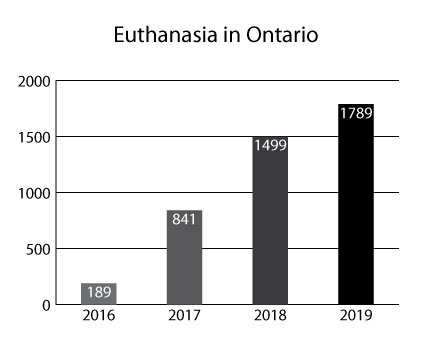
The Ontario Office of the Chief Coroner released the updated data for MAiD (euthanasia and assisted suicide deaths) indicating that from June 17, 2016 until December 31, 2019 there have been 4318 reported assisted deaths in Ontario.

According to the data, there were 1789 reported assisted deaths in 2019, 1499 in 2018, 841 in 2017 and 189 in 2016.

There was a significant increase in the second half of 2019 with 1015 reported assisted deaths up from 774 reported assisted deaths in the first half of the year in Ontario.

recent article in the Calgary Herald, reported that there has also been a significant increase in reported assisted deaths in Alberta with 377 in 2019, 307 in 2018, and 206 in 2017.

Sadly, the increase in assisted deaths is also linked to a wider use of the law. Recently an Ontario doctor agreed to his experience with several controversial assisted dying cases published.
I expect a further increase in assisted deaths since a Quebec court struck down the terminal illness requirement in the law. The Quebec court decision was not appealed by the government causing an incremental extension of the law to people who may be psychologically suffering.

After the government did not appeal the Quebec court decision, Prime Minister Trudeau announced that a first priority for the government is to amend Canada’s euthanasia law.

The Euthanasia Prevention Coalition (EPC) is urging its supporters to participate in the Canadian Department of Justice Medical Assistance in Dying (MAiD) consultation (Link).

Do you have a personal euthanasia story? Sharing your story may help us prevent other euthanasia deaths. Contact us at: 1-877-439-3348 or info@epcc.ca.

USA, California: Controlled Thermal Resources to Supply Imperial Irrigation District with 40 MW Geothermal Energy

IID & Controlled Thermal Resources lead the charge for renewable energy in the U.S. (News Release)

The PPA consists of a 25-year term to supply IID with 40 megawatts of geothermal energy from the Hell’s Kitchen facility

Controlled Thermal Resources (CTR) and Imperial Irrigation District (IID) are pleased to announce the successful completion of a power purchase agreement (PPA) that indicates a promising new decade for baseload renewable energy in California and the United States.

IID and CTR, through its wholly-owned subsidiary, Hell’s Kitchen PowerCo 1, LLC, entered into the PPA on January 7, 2020, regarding the sale of energy from the Hell’s Kitchen geothermal facility.

The agreement consists of a 25-year term to supply IID with 40 megawatts of geothermal energy from the Hell’s Kitchen facility, located at the foot of the Salton Sea in the region’s internationally recognized “Salton Sea Known Geothermal Resource Area.”

The geothermal power facility is expected to be operational in 2023 and will coincide with the development of CTR’s integrated direct lithium extraction and conversion facility (Hell’s Kitchen LithiumCo).

Read More………

Design a site like this with WordPress.com
Get started